
Key takeaways
- Most recurring fights are not really about what they are about. The surface topic changes; the underlying need does not.
- Gottman's research found that 69% of couple conflict is perpetual. Resolution is not the goal. Learning to have the conversation differently is.
- Couples have roughly four core fights: one about being seen, one about being chosen, one about tone and safety, and one about autonomy. Most arguments are one of these in a new context.
- Gridlock happens when both people protect their position because they believe their core need will disappear if they yield. The need itself is never the problem.
- The question that cuts through most recurring fights is: when it is over and you are still turning it over, what is the feeling that is left?
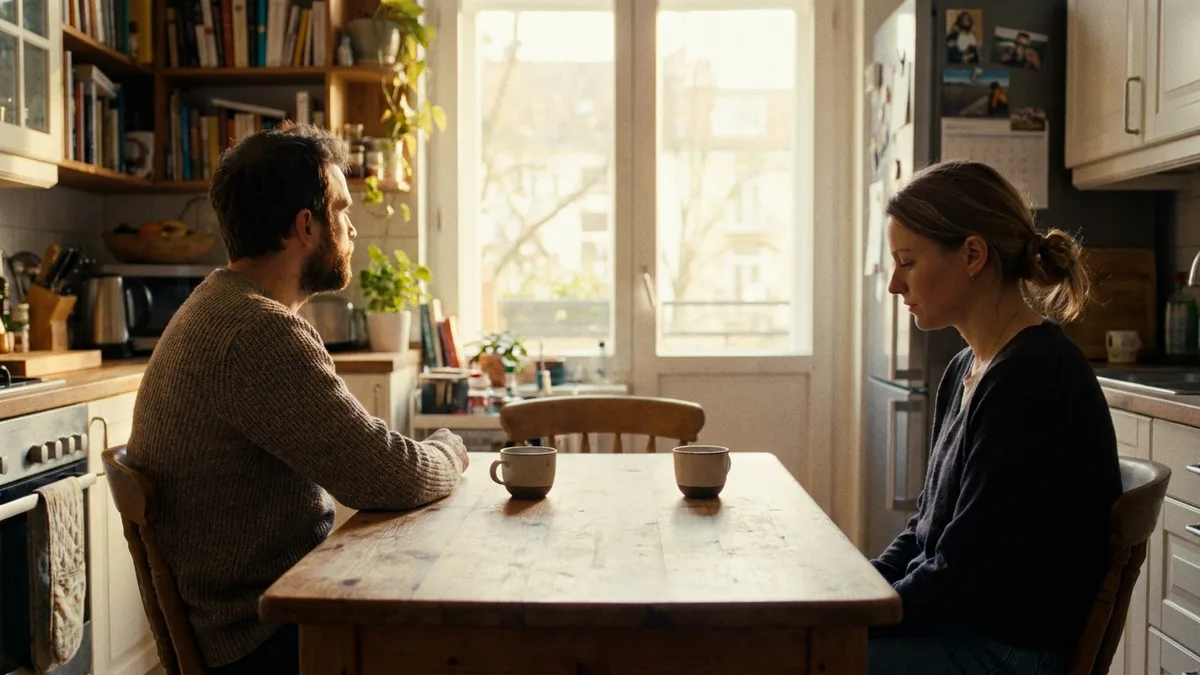
Why couples keep having the same fight
If you find yourself asking "why do we keep having the same fight," the honest answer is that you are probably not having hundreds of different fights. You are having about four, wearing different clothes. The argument about the dishes is often the argument about being seen. The argument about your phone is often the argument about being chosen. The surface topic rotates. The need underneath stays the same.
This is why the same argument keeps coming back: you resolved the episode, not the thing the episode was about.
Gottman's research found that roughly 69% of couple conflicts are perpetual. They are rooted in fundamental differences in personality, values, or needs, and they will not disappear. The couples who stay together do not solve these problems. They learn to talk about them differently, to repair faster when they escalate, and to understand each other's position well enough that the fight loses some of its urgency.
The surface topic is almost never the real fight
Every recurring argument has two layers: the presenting issue and the underlying need. The presenting issue is what you named. The underlying need is what is actually aching.
| What the fight looks like | What it is usually asking | The need underneath |
|---|---|---|
| Household tasks not done or done badly | "Do you see what I carry?" | Being seen and acknowledged |
| Phone out during dinner, work always first | "Where am I on the list?" | Being chosen and prioritized |
| Tone, sarcasm, or how something was said | "I can't relax around this" | Feeling safe and respected |
| Feeling monitored, no space, too many opinions | "I need to exist as a person here" | Autonomy and room to be yourself |
The fight cycles because the presenting issue is addressed ("fine, I'll put the phone away") without the underlying need being acknowledged ("I hear you that you feel like I'm not fully here with you"). One episode resolved. The need still hungry. New episode coming.
Why these fights don't resolve on their own
The Gottman Institute identifies three common mistakes couples make when trying to break the cycle. The first is focusing on "you change." Both partners spend their energy building a case for why the other person is wrong, which produces defensiveness, not movement. The second is escalating, raising the volume or sharpening the tone when the first approach doesn't land. The third is flee and pursue, where one partner withdraws and the other chases, creating a loop where neither feels heard.
All three mistakes have the same structure: both people are protecting a need they believe will be extinguished if they yield. The problem is that yielding on the surface argument is not the same as giving up the underlying need. A person can put down their phone every evening without ever hearing "you matter to me, you are not second to everything else." The fight is waiting on the other side of that gap.
Gridlock sets in when the same argument has run enough times that both partners start approaching it already defended. The topic is mentioned and the nervous system recognises the pattern. This is why some recurring fights feel less like conversations and more like rituals where everyone already knows the lines.
What is the leftover feeling after the fight ends?
This is the question that cuts through most of the noise.
Not what the fight was about on the surface. Not who was right. When it is over and you are still turning it over, what is the feeling that stays with you?
That feeling, more reliably than anything you said during the argument, tells you which fight you are actually having.
What shifts when you can see it clearly
Naming the underlying need changes the conversation. Not easily or immediately, but structurally.
| When you say this | It lands as | What usually comes back |
|---|---|---|
| "You never help around here" | Accusation; triggers defense | "I do plenty, you don't notice" |
| "I feel invisible when the tasks pile up and nothing gets said" | Vulnerability; invites understanding | More likely: "I didn't know you felt that way" |
| "You're always on your phone" | Judgment; triggers justification | "It was work, you're being unreasonable" |
| "I miss you at dinner. I want to feel like I'm the priority sometimes" | Longing; specific and human | More likely: softness, or at least a question |
This is not about choosing careful words to win. It is about making the real fight visible so it can actually be talked about. Most recurring arguments get worse because both people are arguing past each other, defending against a fight that is not quite the one happening.
The answers on Adoree go into more depth on the in-the-moment moves: how to interrupt the escalation, how to take a break without it feeling like abandonment, and how to circle back once the heat is down.
What actually breaks the cycle
Recurring fights do not stop because someone finally wins one. They stop when both people understand each other's position well enough that losing the argument no longer feels like losing something essential.
A few things that actually move it:
- Name the leftover feeling, not the incident. "I'm still sitting with feeling like an afterthought" lands in a different part of the brain than "you did it again."
- Ask what is left for them, too. They have a leftover feeling. It may be completely different from yours. Most couples have never compared notes on this.
- Separate the latest episode from the pattern. "This particular thing" and "this thing we keep doing" are different conversations. Mixing them makes both harder.
- Stop trying to resolve it in the middle of it. Most recurring arguments cannot be solved at 11pm after one of them has been stewing for three hours. The resolution, if it comes, comes from a different kind of conversation at a different moment.
What helps most is both people getting a clear picture of what they each experience and what they each need, without one editing themselves to protect the other or the conversation collapsing into the usual pattern. That kind of structured exchange is what Adoree is built for: both partners heard separately, both perspectives represented together, neither one carrying the argument into it.
For the mechanics of the mid-fight moment, the post on communicating with an avoidant partner is useful even if your partner is not avoidant, because the pursue-withdraw pattern drives a lot of the recurring loops.
The fight is not the problem. What the fight is really about is. You can read more about how Adoree approaches this from both sides.
Frequently asked questions
Why do couples keep having the same fight?
Recurring fights happen because the surface topic is not what the fight is actually about. Most couples are cycling through a small number of unmet needs, feeling unseen, unchosen, unsafe, or controlled. Until the need is named, the argument keeps arriving in new packaging.
What are perpetual problems in relationships?
Perpetual problems are recurring conflicts rooted in fundamental personality or values differences. Gottman's research found they account for roughly 69% of couple arguments. They are not meant to be solved permanently but managed through ongoing dialogue and mutual understanding.
What is gridlock in a relationship?
Gridlock is when a recurring conflict becomes entrenched. Both partners hold their position firmly because they fear losing something core to who they are if they give ground. Gridlock is not a sign the relationship is failing. It is a sign the underlying need has not yet been spoken.
How do you stop having the same argument over and over?
Start by identifying the leftover feeling after the fight ends, not the topic itself. Once you know whether you are fighting about recognition, priority, tone, or autonomy, the conversation can be about that need directly rather than the latest version of the surface argument.
Is it normal to fight about the same things in a relationship?
Yes, and it does not mean the relationship is broken. Couples who stay together long-term do not resolve their perpetual problems. They develop enough understanding of each other's position that they can talk about it without it escalating, and they learn to repair faster when it does.
Meet Adoree.
Adoree is an AI relationship assistant built for couples. It hears both partners privately, remembers everything, and helps you actually move forward. Free for 3 days.
Try Adoree free →Your version of this
You just read about the pattern. Tell me yours — I’ll tell you which one you’re in.
Three messages, free, no sign-up. Nothing is saved unless you keep it.
References
- Managing vs. Resolving Conflict in Relationships. The Gottman Institute. https://www.gottman.com/blog/managing-vs-resolving-conflict-relationships/
- Three Common Mistakes Couples Make During Conflict. The Gottman Institute. https://www.gottman.com/blog/three-common-mistakes-couples-make-during-conflict/
- Conflict Resolution Skills. HelpGuide.org. https://www.helpguide.org/articles/relationships-communication/conflict-resolution-skills.htm