Estranged Meaning: What Estrangement Is and What It Does to Relationships


Is this happening to you? Tell me what's going on. I'll tell you what it's really about.
Key takeaways
- Estranged means 'no longer close,' with an implied history of connection that has since broken down.
- About 27% of American adults report being estranged from at least one family member, according to researcher Karl Pillemer's 2020 national survey.
- The most common causes are emotional abuse, betrayal of trust, significant value conflicts, and unresolved recurring conflict.
- Estrangement within a couple is different from family estrangement but follows the same pattern: gradual emotional withdrawal until the relationship stops functioning.
- Over 50% of family estrangements resolve at least temporarily within a decade, which means the door is not necessarily closed for good.
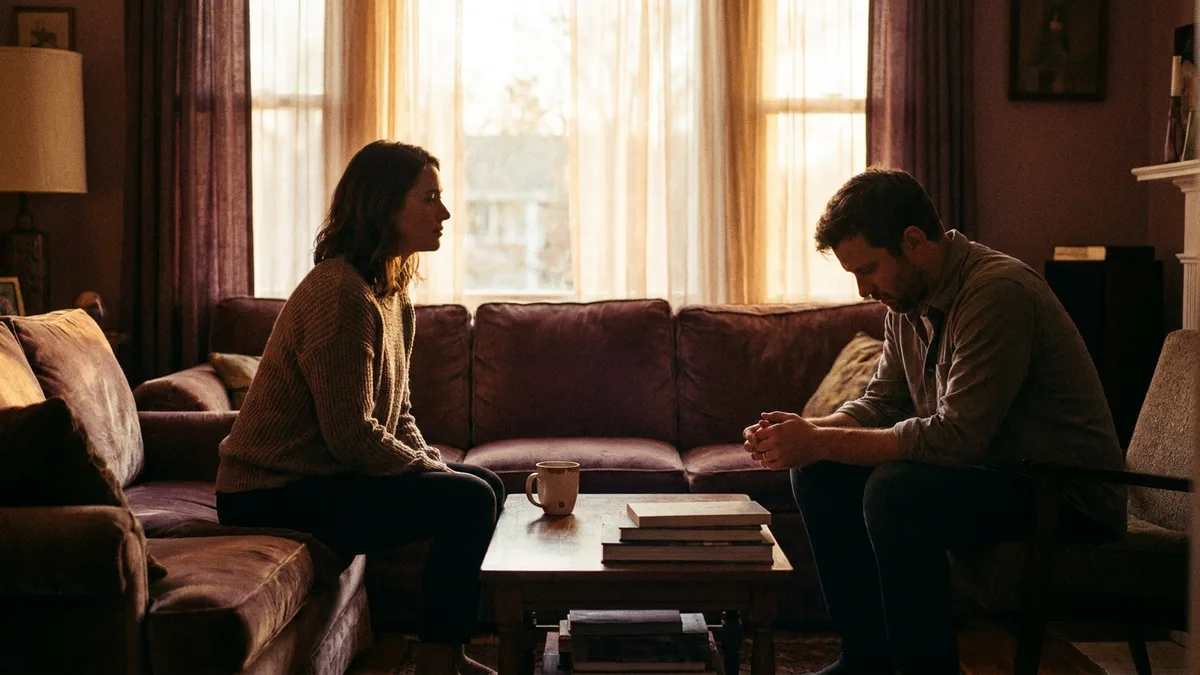
What does estranged mean?
Estranged means no longer close to someone you were once connected to -- and the word carries something more specific than simply "out of touch." It implies a history. It implies that something happened, or that something slowly stopped happening, until the relationship became unrecognizable or disappeared entirely.
The word comes from the Latin extraneus, meaning foreign or external. To be estranged is to have made someone a stranger to you, or to have become a stranger to them.
In everyday use, estranged most often describes a family relationship that has broken down: an estranged parent, an estranged sibling, an estranged adult child. But the concept applies wherever a close bond has fractured -- including between partners.
Estranged vs. distant vs. no contact: what is the difference?
The three terms are often used interchangeably but they describe different things.
| Term | What it means | Key feature |
|---|---|---|
| Distant | Less close than before, possibly drifting | Still in contact; no formal break |
| Estranged | A meaningful relationship has broken down | Prolonged absence of meaningful contact; break is felt |
| No contact | A deliberate decision to stop all communication | Active and intentional; often a protective boundary |
You can be estranged without being fully no-contact. Some estranged family members exchange brief texts at birthdays; others have not spoken in decades. What makes it estrangement is that the relationship, as it once existed, is no longer functioning.
How common is family estrangement?
More common than most people expect -- and far more than is openly talked about.
Sociologist Karl Pillemer's 2020 national survey, published in Fault Lines, found that roughly 27% of American adults are currently estranged from at least one family member. A 2022 YouGov poll put the figure at 29%, broken down as:
| Family relationship | Percentage estranged |
|---|---|
| Sibling | 14% |
| Parent | 11% |
| Child | 9% |
| Grandparent | 5% |
Estrangement is not evenly distributed. Research published in the Journal of Marriage and Family (Reczek, 2023) found significantly higher rates among LGBTQ+ adults: 49% of gay men, 55% of lesbian women, and 38% of bisexual people reported family estrangement, compared to 27% of heterosexual adults. The divergence most often traces to identity-based rejection.
Estrangement is also more common after divorce, when blended family dynamics create new fault lines, and in families with histories of untreated mental illness or substance abuse.
What causes estrangement?
Research from Cambridge University and the UK charity Stand Alone surveyed 807 estranged adults and found a consistent set of causes. Adult children who initiated estrangement most often cited emotional abuse (77% from mothers, 59% from fathers) and profound divergence in values or identity.
A recurring finding across studies is that the two people in an estrangement tend to tell different stories. Adult children frequently cite abuse or neglect; parents frequently describe their child as making choices they cannot understand. Both can be true. Neither is the whole picture.
The most commonly cited causes across research:
- Emotional or physical abuse -- the leading cause for adult children cutting off parents
- Betrayal of trust -- affairs, broken confidences, significant deceptions
- Value and identity conflicts -- sexual orientation, religion, politics, disability, life choices
- Divorce -- creates new conflicts of loyalty and new family configurations that don't always hold
- Substance abuse or untreated mental illness -- makes sustained connection unsafe or impossible
- Unresolved recurring conflict -- fights that never resolve and eventually exhaust the relationship
Researcher Kristina Scharp frames estrangement not as a single event but as a process of ongoing distancing. For many families, it was not one thing. It was an accumulation -- and the final break was simply when one person decided they could not carry the weight of the relationship anymore.
What estrangement does to the people involved
The experience is different depending on which side of the break you are on.
For the person who initiated the estrangement, research finds a surprisingly frequent outcome: relief. A Cambridge study found that 80% of people who cut off a family member reported improved wellbeing, more freedom, and a quieter nervous system. For many, the relationship had been costing them far more than they realized until they were out of it.
For the person who was cut off, the experience is typically closer to grief -- and an unusual kind of grief, because the person is still alive. There is no ritual for it. Friends and colleagues may not understand why you are struggling with the loss of a relationship that the other person simply walked away from. The rejected party often cycles through the same feelings as bereavement: denial, bargaining, anger, and eventually something like acceptance.
For couples, one partner's estrangement from their own family creates secondary effects. The estranged partner may carry unprocessed grief, anger, or shame into the relationship. The non-estranged partner may feel uncertain about holidays, what to say, whether to push or stay quiet. Estrangement in one partner's family of origin is frequently a source of unspoken tension between partners -- not because either person is doing anything wrong, but because there is no shared framework for how to hold it.
Estrangement between partners
Estrangement does not only happen in families of origin. It can happen between two people who are still technically together.
Emotional estrangement between partners is when the relationship structure remains -- shared address, shared finances, possibly shared children -- but the emotional connection has quietly disappeared. Each person is managing their own world. Conversations stay logistical. Conflict either went underground or simply stopped happening because nobody has the energy for it anymore.
This is a close cousin of roommate syndrome in marriage, which describes the specific pattern of living like cohabitants rather than partners. The difference is that full emotional estrangement is more entrenched. The drift has been going on longer. The distance feels less like something that happened and more like something that just is.
The signs that a couple has moved from "drifting" into something closer to estrangement:
- Conversations are purely practical for weeks at a stretch
- Neither person brings up concerns because it feels pointless
- You have stopped making bids for each other's attention and stopped noticing when the other does
- The relationship causes neither connection nor conflict -- it has become neutral
- One or both people feel more like strangers to each other than partners
Gottman's research describes this pattern of emotional withdrawal as one of the quieter and more serious predictors of eventual relationship breakdown -- more concerning in some ways than active conflict, because conflict at least means both people still care enough to fight.
Can estrangement be repaired?
For family estrangement, the data is more hopeful than the experience often suggests. Research from Cambridge and Stand Alone found that over 50% of estrangements resolve at least temporarily within a decade. Some resolve permanently.
What reconciliation rarely looks like is returning to how things were. The relationship that existed before the break is usually gone. What can be built is something new -- with different boundaries, different expectations, and a different understanding of what each person can and cannot offer the other.
For couples who have drifted into emotional estrangement, the repair follows a similar logic: you are not trying to get back to what you were. You are trying to build something new from where you are, with accurate information about where the distance came from.
The silent treatment post covers what happens when one partner's response to estrangement-level distance is to go further into silence -- and what actually breaks that cycle.
When estrangement is the backdrop, not the problem
Couples navigating one partner's family estrangement often find that the estrangement itself is not what they fight about. What they fight about is the downstream stuff: how to spend the holidays, what to tell the children, whether to take calls from the estranged parent, how much of the grief one partner is allowed to bring into the relationship.
These are real and legitimate conflicts. What makes them harder is that the estrangement sits behind all of them like a wall neither person knows how to talk about directly.
If the same fight keeps coming back without resolving, Adoree is built for exactly that dynamic. Each partner gives their side privately, without the other in the room. What comes back is a shared read of both perspectives and a concrete next step for each person. No verdict. No assigning sides. Just an honest account of what is happening for each of you, together.
You can start privately with your own account and understand your own part in the pattern before the conversation happens. That alone changes something. For more on how that works, the about page explains the dual-perspective architecture in full.
The post on recurring fights is a useful companion here -- particularly for couples where the estrangement in one family has been generating the same argument for years without resolving.
Frequently asked questions
What does estranged mean?
Estranged means no longer having a close or connected relationship with someone you were once close to. It implies a history that has since broken -- not just being out of touch, but a relationship that has cooled or been severed, often consciously.
What is the difference between estranged and distant?
Distance is a degree of separation. Estrangement is a break. You can be distant from someone and still be in contact; estrangement usually involves prolonged absence of contact or a formal or informal end to the relationship. Estrangement implies the break matters and is felt by at least one person.
What causes family estrangement?
The most common causes are emotional or physical abuse, betrayal of trust, significant value conflicts (such as around religion, identity, or life choices), divorce, substance abuse, and unresolved long-standing conflict. Researchers note that adult children and parents often give different accounts of the same estrangement.
How common is family estrangement?
Around 27% of American adults experience some form of family estrangement, according to sociologist Karl Pillemer's 2020 national survey published in Fault Lines. A 2022 YouGov poll found 29% of Americans were estranged from a parent (11%), child (9%), sibling (14%), or grandparent (5%).
Does estrangement ever resolve?
More often than people expect. Research from Cambridge and the charity Stand Alone found that over 50% of estrangements resolve at least temporarily within a decade. Some resolve permanently. Reconciliation rarely looks like returning to how things were; it usually involves building a different kind of relationship.
Can a couple become estranged from each other?
Yes. Emotional estrangement between partners is when two people are still technically in a relationship but have stopped being emotionally present to each other. It is a close relative of roommate syndrome -- the relationship structure remains but the connection does not.
Ask Adoree
You just read about it. Now tell me yours — I'll tell you what it's really about.
More on this: Words of modern love, every guide in one place →
References
- Fault Lines: Fractured Families and How to Mend Them. Karl Pillemer, PhD (2020). https://karlpillemer.com/books/fault-lines/
- Family estrangement. Wikipedia, citing Blake, Bland, Golombok (2015) and Reczek (2023). https://en.wikipedia.org/wiki/Family_estrangement
- Almost a third of American adults are estranged from a family member. YouGov (October 2022). https://today.yougov.com/society/articles/44033-almost-a-third-american-adults-estranged-family-member
- Understanding Family Estrangement. Stand Alone Research / Cambridge University (2015). https://www.standalone.org.uk/research/