adoree Ask me in one tap
Key takeaways
- Anxious-anxious pairings create fast, deep connection but also amplified reactivity when either partner senses distance
- Without boundaries, reassurance-seeking spirals into a cycle where both partners escalate instead of grounding each other
- The fix is individual regulation first, then shared rituals that build felt security over time
- Concrete relationship boundaries protect the connection instead of limiting it
- Moving toward earned security is possible for both partners, together
What Happens When Two Anxious Attachment Styles Start Dating?
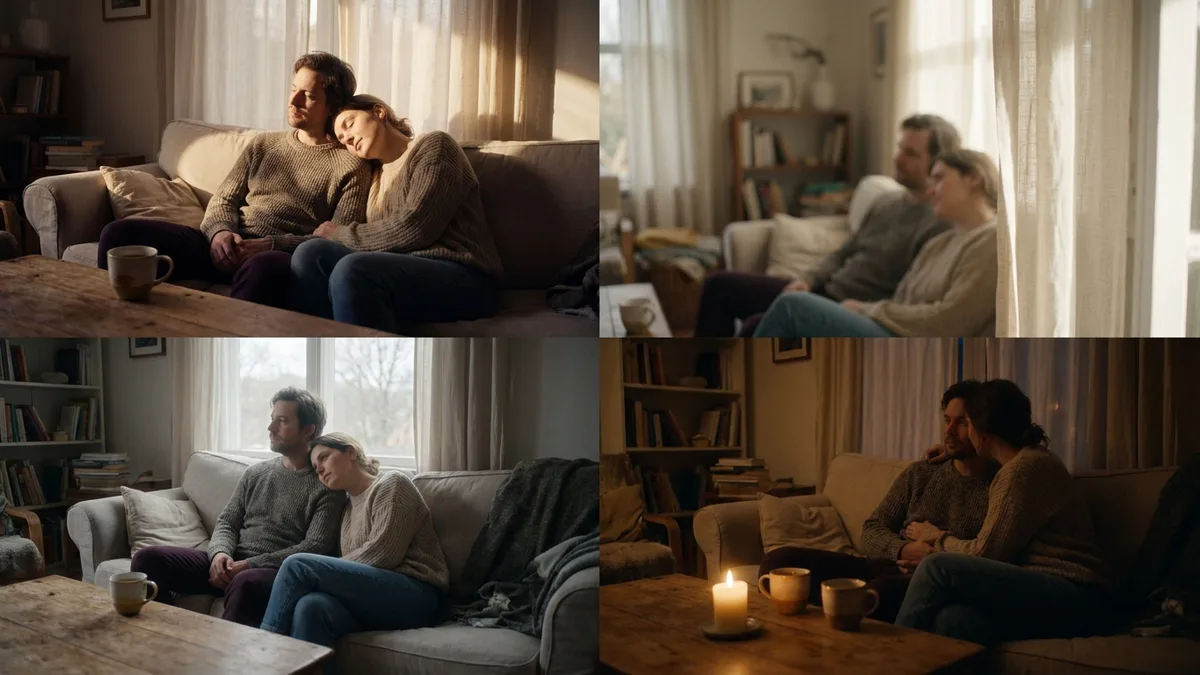
When two people with anxious attachment styles start dating, the early connection feels magnetic. Both partners crave closeness, both are deeply attuned to emotional shifts, and both fall fast. But without self-awareness, that same intensity becomes the thing that destabilizes the relationship.
Anxious attachment affects roughly 20% of adults, according to the foundational research by Hazan and Shaver (1987). That means anxious-anxious pairings are more common than most people think. And unlike the well-documented anxious-avoidant trap, where one partner pursues and the other withdraws, two anxious partners pursue each other simultaneously. The result: intimacy builds quickly, but so does reactivity.
This is the central tension. The desire for closeness is shared. The fear of losing it is shared. And when both people are scanning for signs of distance, small moments get interpreted as threats.
The relationship is not doomed. But it needs something neither partner is used to providing: a grounding presence. Since neither person naturally plays that role, both have to build it intentionally.
That grounding presence can start outside the two of you. When a late text has you spiralling, open Adoree and tell her what just happened. She names the loop while you are still in it and gives you one next step that is not another "are we okay?" Over the weeks, Pulse tracks how secure you actually feel, so you can see the trend instead of judging the relationship by its worst night.
Why Do Two Anxiously Attached People Attract Each Other?
Two anxiously attached people attract each other because they share the same emotional language: closeness equals safety. Both partners respond to early dates with intensity, vulnerability, and a willingness to go deep fast. That mutual openness feels like recognition.
In attachment research, Amir Levine and Rachel Heller describe how anxious individuals have a "highly sensitive attachment system" that activates quickly in romantic contexts. When both people have that same sensitivity, the early stage of dating feels like finally meeting someone who matches your pace.
There are real strengths here:
- Mutual empathy. Both partners know what it feels like to need reassurance, so they offer it willingly.
- Emotional depth. Conversations go beyond surface-level fast. Both people are comfortable with vulnerability.
- Shared motivation. Neither partner plays games or holds back. The investment is obvious from both sides.
The trouble starts when the relationship moves past the honeymoon intensity and into ordinary life. A late text. A distracted evening. A weekend apart. These are normal, but for two anxiously attached partners, each one can feel like evidence of something wrong.
What Does an Anxious-Anxious Relationship Actually Look Like?
The daily experience of an anxious-anxious relationship includes profound closeness alongside sharp reactivity. Both partners read emotional cues with extraordinary precision, but they also misread neutral moments as threatening ones.
Here is how the dynamic typically unfolds across stages:
| Stage | What it looks like | What's happening underneath |
|---|---|---|
| Early dating | Texting constantly, sharing deeply, feeling "seen" | Both attachment systems are activated and reading the intensity as proof of connection |
| Settling in | Frequent check-ins, desire to spend all free time together | Reassurance-seeking becomes the baseline, not a response to actual threat |
| First friction | One partner pulls back slightly; both panic | Neither person has a regulated nervous system to absorb the distance |
| Conflict cycle | Arguments escalate fast, both pursue resolution intensely | Both partners are flooding simultaneously, making de-escalation difficult |
| Repair or rupture | If both learn to pause and self-soothe, the relationship deepens. If not, the cycle repeats | The relationship's future depends on whether regulation becomes a shared skill |
The key distinction between this pairing and an anxious-avoidant one: there is no pursuer and withdrawer. Both partners pursue. That can look like two people arguing passionately about who cares more, or two people frantically reassuring each other while both still feel unsettled.
What Are the Biggest Challenges for Two Anxious Partners?
The core challenge is that neither partner naturally provides the calm, grounded energy that helps an anxious person feel safe. Both are activated at the same time, so conflicts escalate without a natural brake.
Reassurance spirals
Partner A needs reassurance. Partner B gives it, but because Partner B is also anxious, they need reassurance in return. Now both are asking for something neither can fully provide in that moment. The conversation loops instead of landing.
Enmeshment over independence
Two anxious partners can drift into spending all their time together, not because it is chosen but because separation triggers anxiety. Over time, this blurs the line between closeness and codependence.
Difficulty setting boundaries
Both partners may avoid setting dating relationship boundaries because boundaries feel like rejection. Saying "I need an evening alone" can register as "I don't want to be with you" to an anxiously attached partner.
Emotional flooding during conflict
When both partners are flooded at the same time, nobody is calm enough to listen. Arguments become about managing the feeling of threat rather than resolving the actual issue. This is the cycle of fighting that many couples recognize but struggle to break.
| Challenge | How it shows up | What it protects against |
|---|---|---|
| Reassurance spirals | Repeated "are we okay?" conversations that never fully resolve | Fear of abandonment |
| Enmeshment | Canceling plans with friends, guilt about solo time | Fear of being replaced or forgotten |
| Boundary avoidance | Saying yes when you mean no, not voicing needs | Fear that honesty will push the partner away |
| Mutual flooding | Both partners yelling, crying, or shutting down simultaneously | Helplessness when the attachment system is fully activated |
What Are Boundaries in a Relationship, and Why Do They Matter Here?
Boundaries in a relationship are clear agreements about what each partner needs to feel safe and respected. For anxious-anxious couples, boundaries are not walls. They are the structure that prevents the relationship from collapsing under its own emotional weight.
Here are concrete examples of relationship boundaries that work for anxiously attached couples:
Communication boundaries:
- "If I don't reply within an hour, it doesn't mean something is wrong. Let's agree that a delayed text is just a delayed text."
- "When we argue, either of us can call a 20-minute pause. We come back and try again."
Time and space boundaries:
- "Tuesday evenings are mine. I need that time to recharge, and it makes our time together better."
- "We each keep at least one friendship that is ours alone."
Emotional boundaries:
- "I will tell you what I need instead of testing whether you notice."
- "We don't process every hard feeling together in real time. Some things I need to sit with first."
Notice what these examples share: they are specific, they are mutual, and they frame boundaries as something that protects the relationship rather than limiting it. Unhealthy boundaries in relationships, by contrast, tend to be one-sided or controlling: "You can't talk to that person," or "You have to tell me where you are at all times."
The distinction matters for anxious partners especially. When a boundary comes from care rather than control, it actually reduces anxiety over time by creating predictability.
How Do You Build Security in an Anxious-Anxious Relationship?
Building security requires both partners to develop individual regulation skills and then layer shared practices on top. You cannot regulate each other into safety. You regulate yourself, and then you show up more grounded for the relationship.
Individual work
- Name the activation. When your chest tightens or you reach for your phone to check in, pause and label it: "My attachment system is activated. That doesn't mean something is actually wrong."
- Build a self-soothing toolkit. This looks different for everyone: a walk, a breathing exercise, journaling, calling a friend. The point is having something that is not your partner.
- Track patterns. Write down what triggers your anxiety in the relationship. Over time, you will notice that most triggers are interpretations, not facts. Tools like Adoree help both partners identify patterns by listening to each person's perspective separately and surfacing what is actually driving the conflict.
Shared practices
- Check-in rituals. A brief daily conversation about how each person is feeling. Not a temperature check on the relationship, but a genuine "how are you today?" This satisfies the need for connection without making it about reassurance.
- Repair agreements. Decide in advance how you will come back together after a fight. "We take 20 minutes apart, then one of us says 'I want to understand what happened' and the other listens first." Having a script removes the anxiety of not knowing how to reconnect.
- Celebrate independence. When your partner goes out with friends and comes back happy, that is a win for your relationship. Practice seeing their separate life as something that feeds the connection, not threatens it.
How Is Anxious-Anxious Different From Other Attachment Pairings?
Understanding how your specific pairing works helps you stop comparing your relationship to dynamics that do not apply. Here is how anxious-anxious stacks up:
| Pairing | Core dynamic | Strength | Risk |
|---|---|---|---|
| Anxious + Anxious | Both pursue closeness; mutual intensity | Deep empathy, fast intimacy, shared motivation | Mutual escalation, enmeshment, no natural regulator |
| Anxious + Avoidant | One pursues, one withdraws | Strong initial chemistry | Pursue-withdraw cycle that entrenches both styles |
| Anxious + Secure | One seeks reassurance, one provides it steadily | The secure partner models regulation | Anxious partner may still test boundaries |
| Secure + Secure | Both provide and receive steadily | Stable, resilient | Can lack intensity (perceived, not actual) |
The takeaway: anxious-anxious is not the hardest pairing. It is the most intense one. And intensity can be channeled into depth if both people do the work.
Research by R. Chris Fraley at the University of Illinois shows that attachment styles are not fixed traits. They shift in response to relationship experiences. Two anxious partners who build security together can both move toward what researchers call "earned secure attachment," where the felt sense of safety comes from lived experience rather than early conditioning.
What Does Earned Security Look Like in Practice?
Earned security looks like the moment when your partner's phone dies and you notice the old panic rising, and then it passes. You trust that they will call when they can. You do not spiral through worst-case scenarios. You go about your evening.
It also looks like:
- Disagreeing without either person interpreting the disagreement as a threat to the relationship
- Spending a weekend apart and feeling genuinely glad to see each other Monday, not relieved that they came back
- Saying "I felt hurt when you said that" without bracing for the relationship to end
- Asking for what you need directly instead of hinting and then resenting the miss
This does not happen overnight. Attachment researchers estimate that meaningful shifts in attachment style take months to years of consistent, corrective experiences. But the shift is real, measurable, and available to both partners simultaneously.
Adoree is built for exactly this kind of slow, steady shift. Each of you can talk to her privately when the old panic rises, and the weekly Pulse check-in shows whether "Feeling Secure" is moving week to week. When you want to understand the pattern itself, Masterclass classes like "Emotional Bids & Turning Toward" walk you through it, all for $9.99/month after a 3-day free trial.
When Should You Get Outside Help?
Not every anxious-anxious couple needs outside support. But there are clear signals that the work has outpaced what you can do on your own:
- The same argument happens weekly with no change in outcome
- One or both partners feel unable to function during time apart
- Arguments regularly escalate into yelling, name-calling, or emotional shutdown
- Either partner has started avoiding honest conversation to keep the peace
- The relationship feels like the only source of emotional stability for both people
These are not signs of failure. They are signs that your nervous systems need more support than self-help alone provides. Whether that support comes from a professional, from structured AI tools, or from a combination, the willingness to seek it is itself a move toward security.
Moving Forward Together
Two anxious attachment styles dating is not a red flag. It is a specific dynamic with specific strengths and specific risks. The intensity is real. The love is real. And so is the work required to channel one into the other.
Start with one boundary. Practice one self-soothing strategy. Have one conversation where you listen without defending. These are small moves, but they are the ones that actually change the pattern.
The couples who make this pairing work are not the ones who stop feeling anxious. They are the ones who learn to feel anxious and still choose trust.
Frequently asked questions
Can two people with anxious attachment have a healthy relationship?
Yes. Research shows attachment styles can shift toward security over time. Two anxious partners who build self-regulation skills, set clear boundaries, and communicate without blame can create a stable, deeply connected relationship. The shared desire for closeness is an asset once the reactivity is managed.
What does an anxious-anxious relationship look like day to day?
Expect intense emotional closeness, frequent check-ins, and a strong desire to be together. The challenge shows up when one partner pulls back even slightly. Both feel the distance immediately, and without regulation skills, small moments of withdrawal can trigger outsized reactions from both sides.
How is an anxious-anxious pairing different from anxious-avoidant?
In anxious-avoidant dynamics, one partner pursues while the other withdraws, creating a push-pull cycle. In anxious-anxious pairings, both partners pursue simultaneously. This means faster intimacy but also mutual escalation during conflict, since neither partner naturally downregulates the other.
What are examples of healthy boundaries in an anxious-anxious relationship?
Examples include agreeing on response-time expectations for texts, keeping separate friendships and hobbies, pausing heated conversations with a specific re-engagement time, and checking in about needs without requiring immediate reassurance. Boundaries give both partners predictability, which calms the anxious system.
When should an anxious-anxious couple get outside support?
If the same conflict repeats weekly, if either partner feels they cannot function without the other's constant presence, or if arguments regularly escalate into yelling or shutting down. An AI relationship assistant like Adoree can help both partners see their patterns clearly and build practical communication habits.
Catch the spiral before it catches you both.
Talk to Adoree privately the moment the loop starts, and watch "Feeling Secure" move in your weekly Pulse. Free for 3 days, then $9.99/month.
Try Adoree free →Ask Adoree
One of you chases, one of you pulls away? Tell me how it plays out — I'll name the dance.
References
- Romantic Love Conceptualized as an Attachment Process. Hazan & Shaver (1987), Journal of Personality and Social Psychology. https://labs.psychology.illinois.edu/~rcfraley/attachment.htm
- Attached: The New Science of Adult Attachment. Amir Levine & Rachel Heller (2010), TarcherPerigee. https://www.attachedthebook.com/wordpress/about-the-book/
- A Brief Overview of Adult Attachment Theory and Research. R. Chris Fraley, University of Illinois. https://labs.psychology.illinois.edu/~rcfraley/attachment.htm
- Attachment Styles and Mental Health Care Utilization. Ciechanowski et al. (2015), PLOS ONE. https://pubmed.ncbi.nlm.nih.gov/26213376/