

That spiral when they go quiet has a pattern. Tell me what sets yours off.
Key takeaways
- Anxious attachment is a habit of staying close by staying alert: watching for signs of love and signs of leaving at the same time.
- Attachment theory began with John Bowlby and Mary Ainsworth. Hazan and Shaver showed in 1987 that the same patterns appear in adult romance.
- The signs show up under uncertainty: a slow reply, a change in tone, a partner who needs space.
- Anxious and avoidant partners often pull each other into a chase. Naming the loop is the first step out of it.
- It can change. A study spanning 59 years found attachment anxiety tends to decline after young adulthood, and being in a relationship predicted lower levels.
What is anxious attachment?
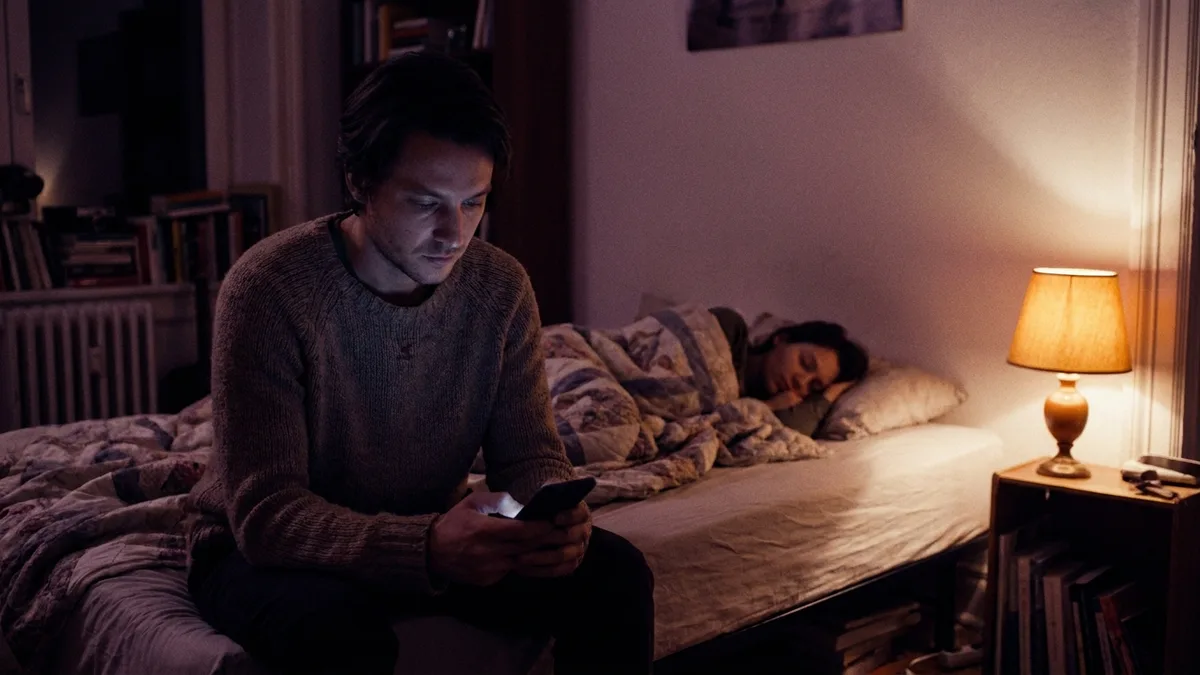
Anxious attachment is an attachment style where a person wants closeness deeply and worries it could vanish. People with an anxious attachment style tend to watch a partner closely for signs of love and signs of leaving, seek reassurance often, and feel a surge of panic when contact drops. It is a pattern learned early, often from care that was loving but unpredictable, and it can change.
You may know it as anxious preoccupied or anxious-ambivalent attachment. They all describe the same thing: a love life run by an alarm that goes off too easily.
Three things to hold onto before going further:
- Anxiety is a strategy. It made sense once. If comfort came sometimes and not others, staying alert and asking loudly was the smart move.
- It is a description, never a diagnosis. Researchers measure it on a scale, and everyone has some.
- It lives between two people. It shows up most in a relationship, which is also where it eases.
That last point is why the most useful view of anxious attachment includes both partners. Adoree, an AI relationship assistant, talks to each of you privately, so the person who needs reassurance and the person who needs a minute can each say their side before the other's reaction fills the room.
For all four styles and how they pair up, see our attachment styles hub.
Where anxious attachment comes from
Anxious attachment usually starts in childhood, when a child learns that comfort is available but not reliable. Attachment theory began with British psychiatrist John Bowlby, who argued that a baby's crying, clinging and searching are adaptive responses to being separated from a caregiver. Psychologist Mary Ainsworth then gave the theory its most famous test.
In Ainsworth's "Strange Situation," a one-year-old is briefly separated from a parent and then reunited. Researchers still describe it as the gold standard for classifying infant attachment. Ainsworth saw three patterns. Secure babies were upset when the parent left and easy to comfort on return. Avoidant babies seemed unbothered. A third group, which she called anxious-resistant, were very distressed, hard to soothe, and often clung to the parent and pushed them away in the same moment, according to psychologist R. Chris Fraley's overview of the research.
In 1987, Cindy Hazan and Phillip Shaver asked whether the same patterns appear in adult love. Using a short three-paragraph questionnaire, they found secure, avoidant and anxious styles in romantic relationships, in roughly the same proportions as in infancy: about 60% secure, 20% avoidant and 20% anxious, as Fraley summarizes. The anxious description in their questionnaire includes worrying that a partner "doesn't really love me" and noticing that their wish for closeness "sometimes scares people away."
Today, most researchers describe adult attachment on two scales, anxiety and avoidance. Anxiety is how much you worry about whether a partner is there for you. Avoidance is how uncomfortable you are relying on anyone. An anxiously attached person is high on the first and lower on the second.
Childhood is only part of the story. The link between how secure you were as a baby and how secure you feel in love as an adult is real but modest. Later experiences count too. A breakup that came out of nowhere or a partner who ran hot and cold can teach the same lesson in adulthood.
Signs of anxious attachment in yourself
The signs of anxious attachment show up under uncertainty. In calm, connected stretches, an anxiously attached person can be warm, generous and fun to be with. The pattern appears when something feels unclear: a slow reply, a flat tone, a change of plans.
Common signs:
- Reading the gaps. You check when they were last online, reread your own messages for mistakes, and build a story out of a delay.
- Needing reassurance often. One "I love you" calms you for an hour, then the doubt returns.
- Treating distance as a verdict. When a partner wants a night alone, part of you hears "I'm leaving."
- Not being able to drop a fight. You need it fixed now, because sleeping on it feels unbearable.
- Over-giving. You say yes to things you don't want, to keep the relationship feeling safe.
- Protest behavior. When you feel ignored, you might call repeatedly, go cold on purpose, or make your partner a little jealous, hoping they'll come closer.
- Losing yourself. Your mood rises and falls with how the relationship feels today.
Researchers describe these moves as hyperactivating strategies. One review calls it a "hypervigilant" form of coping and notes that anxious people are "vigilant to signs of both their partner's love and possible rejection." The vigilance is exhausting, and it often finds what it is looking for, because almost any message can be read as distance when you are scared.
If some of this sounds familiar, our guide on CBT for anxious attachment style shows how to catch and test the thoughts that drive the spiral.
Signs of anxious attachment in a partner
From the outside, anxious attachment can look like neediness. From the inside, it feels like fear. If your partner has an anxious style, you may notice:
- They ask "are we okay?" after small disagreements, or several times in one evening.
- They get upset when you're slow to text back, even when you were simply busy.
- They want to talk things through right away, while you want time to think.
- They read your quiet mood as being about them.
- They are very attentive and generous, and sometimes keep score of whether that is returned.
None of this means they don't trust you as a person. It means their alarm system trusts distance even less. A partner's patience helps most when it comes with clear, predictable signals, which we'll get to below.
Anxious vs avoidant attachment
Anxious and avoidant attachment are two answers to the same question: what do I do when I'm not sure you're there for me? The anxious answer is to move closer. The avoidant answer is to move away. Fraley describes avoidance as preferring not to rely on others or open up to them, which is close to the opposite instinct.
| Anxious attachment | Avoidant attachment | |
|---|---|---|
| Core fear | Being left or unloved | Being swallowed or let down |
| Under stress | Reaches out, seeks contact | Pulls back, seeks space |
| Strategy | Hyperactivating: turn the signal up | Deactivating: turn the signal down |
| In conflict | Wants to fix it now | Wants to stop talking about it |
| What it can look like | Clingy, intense | Cold, distant |
| What it feels like inside | Panic, longing | Overwhelm, pressure |
Both are insecure styles, and both made sense once. Neither one is the "bad" partner.
The anxious-avoidant pull
Anxious and avoidant people are often drawn to each other, and the pairing can turn into a loop. The anxious partner reaches for reassurance. The avoidant partner feels crowded and steps back. The step back confirms the anxious partner's fear, so they reach harder. The harder reach confirms the avoidant partner's fear of being overwhelmed, so they retreat further.
From inside the loop, each person feels like the reasonable one. That is what makes it so sticky.
What breaks it:
- Name the loop out loud. "I think we're doing the chase thing again" takes the blame off both of you and puts it on the pattern.
- Agree on a pause with a return time. The avoidant partner gets space, and the anxious partner gets a clock. "I need 30 minutes, and then I'm coming back to this" works far better than walking out.
- Ask for the specific thing. "Can you text me when you land?" is easier to give than "I need you to make me feel secure."
- Go first, in small ways. The anxious partner tries soothing themselves for ten minutes before reaching out. The avoidant partner offers a small reassurance before it's asked for.
For the avoidant side of this, see our guides on avoidant attachment and how to communicate with an avoidant partner. If you're both on the anxious side, two anxious attachment styles dating covers that pairing.
How to calm anxious attachment day to day
You can't argue an alarm into silence, but you can teach it that it doesn't need to ring so loud. These are small, repeatable moves.
Notice the trigger, then name the story. When the panic hits, say to yourself what happened (they haven't replied in three hours) and then the story you've added (they've lost interest). Seeing the two side by side often shrinks the story.
Wait before you act. Set a short timer, ten or twenty minutes, before you send the second text or make the call. Breathe slowly, walk, do something with your hands. Most spikes fall on their own if you give them a little time.
Ask for reassurance directly. Protest behavior, like going cold to get a reaction, rarely gets you what you want. A plain request usually does: "I'm feeling a bit wobbly tonight. Can you tell me we're okay?"
Build a life that holds you. Friends, work you care about, a body you move, sleep. The more your sense of safety rests on many things, the less weight any single text has to carry.
Collect evidence of reliability. Anxious memory is very good at storing the times someone let you down. Make a point of noticing the times they showed up.
Read, then practice. Books can give you the language for what you're feeling. Our list of the best anxious attachment style books covers which ones are worth your time and how to use them without just collecting insights.
How a partner can help
A partner can't fix anxious attachment, but they can make it a lot quieter. Research on what Jeffry Simpson and Nickola Overall call partner buffering found that anxious people do better when partners use behaviors that "reassure them they are loved and supported." In one conflict study, more committed partners of anxious people made more accommodating moves, and that reduced the anxious partner's distress.
In practice, that looks like:
- Be predictable. Say when you'll be back, and be back then. Consistency calms the alarm faster than grand gestures.
- Reassure before you're asked. A quick "thinking of you" in a busy day costs little and saves a lot.
- Close the loop after conflict. Even if you need time, say so, and say you're coming back. "I'm not going anywhere, I just need an hour" is the sentence.
- Don't punish the fear. "You're being needy" makes the alarm louder. "I can see you're worried, and I'm here" makes it softer.
- Keep your own needs on the table. Helping an anxious partner doesn't mean giving up your space. It means explaining it, so space doesn't look like leaving.
This is where hearing both sides helps. Adoree talks to each partner privately and gives each of you honest feedback, so the reassurance one person needs and the room the other needs can both be said without either feeling like the problem.
Can anxious attachment change?
Yes. Attachment is only moderately stable over a lifetime, and the research is encouraging. A study by William Chopik and colleagues stitched together data from 628 people aged 13 to 72, tracked across five projects, to cover 59 years. Attachment anxiety tended to rise into young adulthood and then decline through middle and older age, and at every stage, being in a romantic relationship was linked to lower anxiety. The authors note these are group averages, not a promise for any one person.
Researchers use the term earned security for adults who started out insecure and became secure. In a 23-year study, Glenn Roisman and colleagues found that people who were insecurely attached as babies and later became secure went on to have successful close relationships. Where you started is not where you have to stay.
What tends to help:
- A steady relationship where reassurance is reliable and conflict gets repaired.
- Practice at self-soothing, so the alarm can quiet without someone else always turning it off.
- Understanding your history, enough to see that the panic is often older than the person in front of you.
- Professional support, especially approaches that work on thoughts and patterns directly.
When to get professional help
Some anxiety in love is ordinary. Consider talking to a licensed therapist if:
- Worry about the relationship is taking over your days, your sleep or your work.
- You feel panic or despair most times a partner is out of reach.
- The same painful pattern has repeated across several relationships.
- Anxiety about love sits alongside broader anxiety, low mood or past trauma.
- You and your partner are stuck in the same fight and can't get out of it on your own.
Many people find individual therapy helps with the history, and couples work helps with the loop. If you're curious what one well-studied method looks like, start with our guide to CBT for anxious attachment.
Anxious attachment is a careful, loving system that learned to watch too hard. With a little help, it can learn to rest.
If you are ever in crisis, call or text 988 in the US. If a partner is controlling or harming you, the National Domestic Violence Hotline is 1-800-799-7233.
Frequently asked questions
What is anxious attachment in simple terms?
Anxious attachment is a pattern where you want closeness very much and worry it could be taken away. People with this style tend to watch a partner's mood and replies closely, need reassurance more often, and feel a rush of panic when contact drops. It usually starts in childhood as a response to care that was warm at times and unavailable at others.
What are the signs of anxious attachment?
Common signs include overthinking texts and reply times, needing frequent reassurance, reading distance as rejection, finding it hard to calm down after a disagreement until things are fixed, giving more than you get to keep the peace, and feeling unsettled when a partner wants time alone. One sign means little. A steady pattern means more.
What triggers anxious attachment?
Uncertainty is the main trigger. A slower reply than usual, a flat tone, plans that change, a partner going quiet after a fight, or a partner spending time with other people can all set off the alarm. The trigger is usually small. The feeling it sets off is big, because it taps an older fear of being left.
Can anxious attachment be fixed?
Yes, it can change. Attachment is only moderately stable over a lifetime, and a long-term study following people from age 13 to 72 found that attachment anxiety tended to fall after young adulthood. Steady, responsive relationships, skills for calming yourself, and support from a therapist can all help a person move toward what researchers call earned security.
What is the difference between anxious and avoidant attachment?
Both are insecure styles, and they handle the same fear in opposite ways. An anxiously attached person moves toward a partner when they feel unsure, seeking contact and reassurance. An avoidantly attached person moves away, seeking space and self-reliance. That is why the two often end up in a chase, with one pursuing and the other retreating.
Can two anxiously attached people be together?
Yes. Two anxious partners often feel deeply understood by each other, and they can also feed each other's worry when both are triggered at once. What helps is agreeing on simple rules for reassurance and for pauses during conflict, so both people can calm down without either one feeling abandoned.
Is anxious attachment a mental illness?
No. Anxious attachment is a relationship style that many ordinary, healthy people have to some degree. It is not a diagnosis. It can overlap with anxiety or depression, and if worry about your relationship is taking over your days, a licensed mental health professional can help you sort out what is going on.
Say the worry out loud, before it turns into a fight.
Talk to Adoree privately, by voice or text, whenever the alarm goes off. Adoree hears your side, and your partner's if they join, and helps you ask for what you need in words that land.
Talk to Adoree →Ask Adoree
One of you chases, one of you pulls away? Tell me how it plays out — I'll name the dance.
More on this: Attachment styles, every guide in one place →
References
- A Brief Overview of Adult Attachment Theory and Research. R. Chris Fraley, University of Illinois. https://labs.psychology.illinois.edu/~rcfraley/attachment.htm
- Romantic Love Conceptualized as an Attachment Process. Hazan and Shaver, Journal of Personality and Social Psychology (1987). https://doi.org/10.1037/0022-3514.52.3.511
- Contributions of Attachment Theory and Research: A Framework for Future Research, Translation, and Policy. Cassidy, Jones and Shaver, Development and Psychopathology (2013). https://pmc.ncbi.nlm.nih.gov/articles/PMC4085672/
- Partner Buffering of Attachment Insecurity. Simpson and Overall, Current Directions in Psychological Science (2014). https://pmc.ncbi.nlm.nih.gov/articles/PMC4157676/
- First study to investigate how attachment style changes through multiple decades of life. BPS Research Digest (2019), on Chopik, Edelstein and Grimm, Journal of Personality and Social Psychology. https://www.bps.org.uk/research-digest/first-study-investigate-how-attachment-style-changes-through-multiple-decades-life
- Longitudinal Changes in Attachment Orientation Over a 59-Year Period. Chopik, Edelstein and Grimm, Journal of Personality and Social Psychology (2019). https://doi.org/10.1037/pspp0000167
- Earned-Secure Attachment Status in Retrospect and Prospect. Roisman, Padrón, Sroufe and Egeland, Child Development (2002). https://doi.org/10.1111/1467-8624.00467