Tradwife: What It Means, Why It Appeals, and How Couples Can Talk About It
adoree Ask me in one tap
Key takeaways
- Tradwife is a blend of 'traditional' and 'wife'. Researchers trace its modern form to a 2020 BBC interview with British homemaker Alena Pettitt.
- The trend spread on TikTok and Instagram through creators like Hannah Neeleman (Ballerina Farm) and Nara Smith, both of whom have pushed back on the label.
- Supporters describe relief from the pressure to have it all. Critics worry about financial dependence, a curated aesthetic, and links between some accounts and far-right ideas.
- Pew found husbands were the main or sole earner in 55% of US marriages in 2022, down from 85% in 1972.
- Any single-income arrangement works better with a written money plan, retirement savings in both names, and regular check-ins on whether the split still fits.
What is a tradwife?
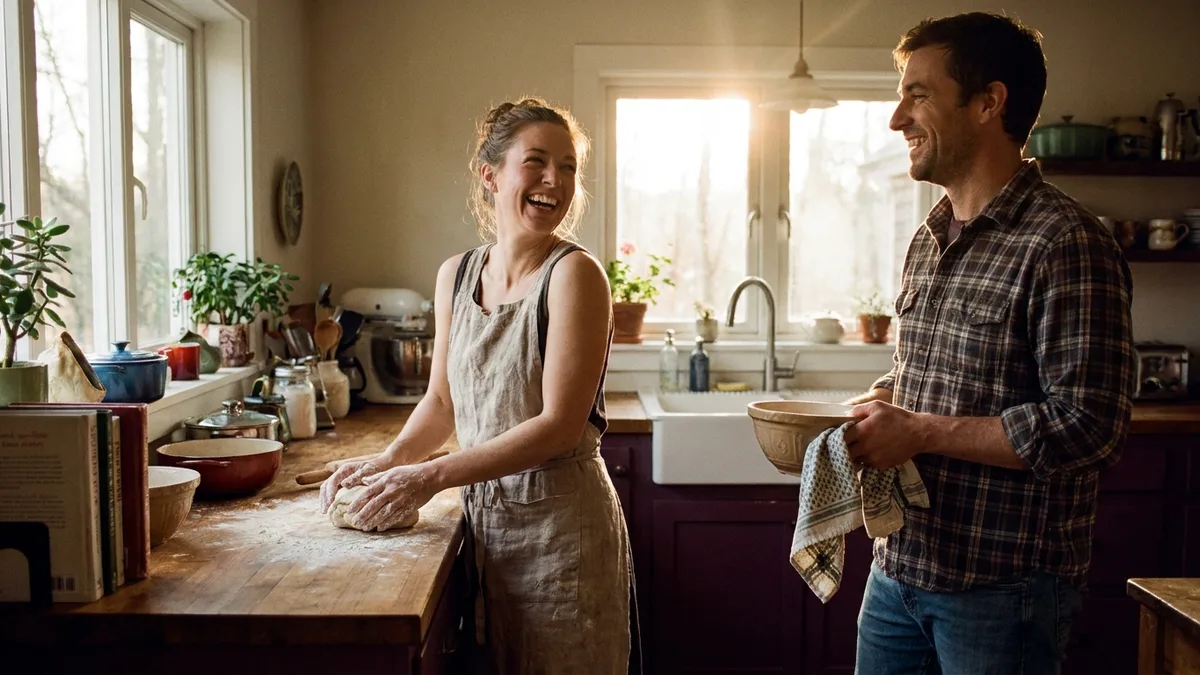
A tradwife, short for traditional wife, is a woman who embraces traditional gender roles in marriage: she runs the home and raises the children while her husband earns the income. The word is mostly used for women who share that life online, in videos of bread from scratch, linen aprons and quiet kitchens.
To some viewers it looks like peace. To others it looks like a step back for women. And in plenty of homes, it has become a real conversation: one partner half-wants that life, the other is worried about what it means, or a parent sees it in a daughter's feed.
This guide explains the tradwife trend fairly: where it came from, who made it famous, why it appeals, what critics say, and what the research shows. Then the part that matters at home: how a couple can divide roles by choice, protect the partner without an income, and talk about it without contempt. If you want to sort out your own view first, Adoree, an AI relationship assistant, gives each partner a private space to think out loud, and hears both sides.
Trad wife meaning and where the word came from
Tradwife is a blend of "traditional" and "wife". Wanting a homemaker life is old. The modern label is recent. A 2026 study in Media and Communication traces its current form to a 2020 BBC interview in which British homemaker Alena Pettitt described submitting to and spoiling her husband "like it's 1959".
From there the hashtag spread on TikTok and Instagram, where creators filmed cooking, cleaning and childcare styled after the 1950s, the frontier or a soft-focus farmhouse, as Wikipedia's overview of the trend describes.
It helps to separate three things the word gets used for:
| Term | What it usually means |
|---|---|
| Stay-at-home parent | A practical arrangement: one parent is home with the children |
| Homemaker | Running the household as your main work, by choice or circumstance |
| Tradwife | Homemaking plus a belief that these roles suit women and men naturally, often shared publicly online |
Many stay-at-home parents would never call themselves tradwives. Some tradwives work, and some of them run businesses.
The tradwife trend: influencers and backlash
Two creators became the faces of the trend, and neither fully accepts the label.
Hannah Neeleman runs Ballerina Farm in Utah. A Juilliard-trained ballerina with eight children and more than 9 million Instagram followers, she was profiled by The Times in July 2024 under the "tradwife" banner. She told the reporter, Megan Agnew, "I don't necessarily identify with it," according to the Deseret News. The profile set off a wide online debate about the marriage and the work behind the image.
Nara Smith, a model, went viral for cooking elaborate meals from scratch in designer dresses. On the Call Her Daddy podcast she rejected the label: "I'm a working mom."
That gap is the heart of the backlash. Creators sell an image of a simple, single-income life, while running content businesses that earn their own money.
Why the tradwife lifestyle appeals
It is easy to sneer at tradwife content. It is more useful to ask why millions of people watch it, including many who would never live it.
Researchers who followed 36 tradwife creators over ten months, Sykes and Hopner, describe the pull as stability and purpose in a world that asks women to do more, escapist and nostalgic content, and a community that validates the choice. In the Media and Communication study, women interviewed about the trend suggested it can feel like relief from the pressure to have a career, be a devoted mother and be a perfect partner all at once.
Put plainly: if you are exhausted from doing everything, a video of someone doing one thing calmly looks like rest. That feeling deserves to be taken seriously, even if you land on a different answer.
What critics say about tradwives
The criticism falls into three groups.
| Criticism | What it means |
|---|---|
| Economic dependence | One partner without income, savings or recent work history is exposed if the marriage ends or the earner gets sick |
| Aesthetics vs reality | Polished videos hide paid help, family money, business income and the sheer labour of a home |
| Ideology | Some accounts promote wifely submission, anti-feminism or far-right ideas behind an apolitical look |
On the last point, the research is careful. Sykes and Hopner found views ranging from conservative traditionalism to white supremacy, and argue the trend turns unpaid domestic work into monetised content. A GNET analysis of tradwife memes by Frenguelli and Watkin is explicit that not everyone who identifies as a tradwife takes part in radical right or white supremacist movements, and that its analysis does not cover women who simply choose to stay at home. The same online world has a male mirror in the manosphere, where some creators sell men a matching script about who should lead at home.
So the fair summary is this: homemaking is not the problem critics are pointing at. Dependence without protection, and ideas that put one partner beneath the other, are.
The money question: single income, real risk
Single-earner marriages are less common than the videos suggest. Pew Research Center found husbands were the main or sole earner in 55% of US opposite-sex marriages in 2022, down from 85% in 1972. Husbands were the sole earner in 23%, down from 49%.
| US marriages, 2022 | Share | In 1972 |
|---|---|---|
| Husband is main or sole earner | 55% | 85% |
| Husband is sole earner | 23% | 49% |
| Both earn about the same | 29% | 11% |
| Wife is main or sole earner | 16% | 5% |
The risk shows up if the relationship ends. Using Australian household survey data, economists Guyonne Kalb and Barbara Broadway found a breakup cut women's disposable household income by almost 30% on average, against 5% for men. Women who had no job before the breakup were among the most vulnerable.
None of this says a single income is wrong. It says the partner at home needs a safety net that does not depend on the marriage going well.
Dividing roles by choice: a couple's checklist
If one of you wants a more traditional setup, these are the conversations that make it a real choice for both:
- Name the deal. Who earns, who runs the home, and for how long. Write it down and set a date to revisit it.
- Make money visible. Joint access to accounts, shared budget, no allowances. A partner who has to ask for money is not an equal.
- Save in both names. In the US, a spousal IRA lets a lower-earning spouse contribute based on the couple's combined pay when you file jointly. In the UK, claiming Child Benefit for a child under 12 gives the parent at home National Insurance credits toward their State Pension.
- Keep a route back to work. A qualification, a part-time client, a network. Life changes.
- Share the invisible work. Staying home does not mean carrying every plan in your head. Our guide to mental load in a relationship shows how to split the thinking, not just the chores.
- Watch for opting out. The earner still parents and still knows where the spoons live. If "I'm hopeless at that" becomes a habit, read about weaponized incompetence.
It also helps to know where most people land. Pew found 77% of Americans say children are better off when both parents focus equally on work and home, while 19% prefer the father focused on work and the mother on home. Both answers exist in real, happy marriages. The one that works is the one you both chose.
How to talk about it when you disagree
Maybe she has been watching tradwife videos and wants to stop working. Maybe he wants a traditional wife and she does not. Maybe it is the reverse. The conversation goes better when you talk about needs, not labels.
| Instead of this | Try this |
|---|---|
| "So you want to be a 1950s housewife?" | "What about that life appeals to you right now?" |
| "You'd be throwing your career away." | "I'm scared of you having no money of your own. Can we plan for that?" |
| "Women belong at home." | "I'd love more time together at home. What would that take for both of us?" |
| "That's just anti-feminist nonsense." | "Some of those accounts worry me. Can I tell you which bits and why?" |
Keep the mockery out on both sides. An eye-roll at the apron, or at the career, turns a choice into a contest of worth. That is contempt, and once it sets in, the roles stop being the real argument.
Where the line is
A traditional division of roles is a choice. Control is not. Financial abuse, as described by the National Domestic Violence Hotline, includes a partner monitoring and questioning every purchase, giving an allowance only for what they approve, interfering with your work, or taking money you earn. If you are being told what to wear, cut off from friends, or punished for not obeying, that is control, whatever name it goes by.
If that is happening, you deserve support:
- US: National Domestic Violence Hotline, 1-800-799-7233, or text START to 88788, 24/7.
- UK: National Domestic Abuse Helpline, run by Refuge, 0808 2000 247, 24 hours.
How Adoree helps you both decide
The hardest part is often saying what you want before you know whether your partner will laugh at it. Adoree gives each of you a private space to work that out. One of you can admit you are tired of the career treadmill. The other can admit the idea of being the only earner is frightening. Adoree hears both sides and helps you turn two private worries into one plan you both chose.
For plain explanations of more terms couples argue about, see the words of modern love, or read who builds Adoree and why.
Frequently asked questions
What is a tradwife?
A tradwife, short for traditional wife, is a woman who embraces traditional gender roles in marriage: running the home, raising children and supporting a husband who earns the income. The word is mostly used for women who share that lifestyle on TikTok, Instagram and YouTube, often with a 1950s or farmhouse aesthetic.
What does trad wife mean?
Trad wife means traditional wife. It describes a woman who chooses homemaking and childcare as her main role while her partner provides financially, and who usually believes those roles suit men and women naturally. Some use it simply for a stay-at-home lifestyle, while others tie it to submission to a husband or to anti-feminist politics.
Where did the tradwife trend come from?
Researchers trace the modern tradwife to British homemaker Alena Pettitt, who described her lifestyle in a 2020 BBC interview as submitting to and spoiling her husband like it was 1959. The hashtag then spread on TikTok and Instagram, where creators filmed cooking, cleaning and childcare styled after the 1950s or frontier life.
What is the difference between a tradwife and a stay-at-home mom?
A stay-at-home mom describes a practical arrangement: one parent stays home with the children. Tradwife usually adds a belief about gender, that this is the right or natural role for women, and often a public, aesthetic online presence. Many stay-at-home parents do not identify as tradwives at all.
Why is the tradwife trend controversial?
Critics argue it presents financial dependence as safe, hides the paid help and business income behind many accounts, and that some creators promote submission or far-right ideas. Supporters say women should be free to choose home life, and that the backlash dismisses homemaking. Researchers note not all tradwives share extreme views.
Is it okay to want a traditional marriage?
Yes, if it is a real choice for both partners and both are protected. Agree how money will be shared and visible, keep retirement savings in both names, keep some route back to earning, and revisit the arrangement as children grow. The roles matter less than whether both of you still choose them.
Decide the roles together.
Adoree is an AI relationship assistant that talks with each of you privately. Say what you really want from home, work and money, hear the other side, and leave with a plan you both chose.
Talk to Adoree →Ask Adoree
You just read about it. Now tell me yours — I'll tell you what it's really about.
More on this: Words of modern love, every guide in one place →
References
- #TradWives: A Qualitative Meaning-Making Study of Gendered Norms, Moral Appropriation, and Feminism. Heldoorn, Hendrix, Vandeberg and Daalmans, Media and Communication (2026). https://doi.org/10.17645/mac.11927
- Tradwives and the politics of choice. Sykes and Hopner, Sage Perspectives (2025), on their Journal of Contemporary Ethnography study (2024). https://www.sagepub.com/explore-our-content/blogs/posts/sage-perspectives/2025/08/26/tradwives-and-the-politics-of-choice
- In a Growing Share of U.S. Marriages, Husbands and Wives Earn About the Same. Pew Research Center (2023). https://www.pewresearch.org/social-trends/2023/04/13/in-a-growing-share-of-u-s-marriages-husbands-and-wives-earn-about-the-same/
- Women's probability of being in poverty more than doubles after separation. Kalb and Broadway, The Conversation (2022). https://theconversation.com/womens-probability-of-being-in-poverty-more-than-doubles-after-separation-181345