Home · Love, marriage and family in India
Mutual Divorce in India: Process, Cooling Period and How to Talk About It

adoree Ask me in one tap
Key takeaways
- You can file jointly once you have lived separately for a year or more, cannot live together, and both agree to end the marriage.
- There are two motions. The second comes no earlier than six months and no later than eighteen months after the first.
- In Amardeep Singh v. Harveen Kaur (2017) the Supreme Court held the six-month wait is directory, not mandatory, and can be waived on four conditions.
- In Shilpa Sailesh v. Varun Sreenivasan (2023) a Constitution Bench held the Supreme Court can itself grant divorce under Article 142 without the waiting period.
- The decree needs both of you to stay agreed until the end, so settle alimony, custody and property before you file.
- Women are entitled to free legal services. NALSA's helpline is 15100.
What is mutual divorce in India?
Mutual divorce is a divorce both spouses ask for together. You file one joint petition saying you have lived separately for a year or more, cannot live together, and agree the marriage should end. No one has to prove the other did anything wrong. The court hears you twice, at least six months apart, and then grants the decree.
For marriages under the Hindu Marriage Act this is Section 13B. For marriages under the Special Marriage Act it is Section 28, which follows the same pattern. Mutual divorce is usually the quietest route to divorce in India, because the two of you decide the terms instead of a judge deciding who was at fault.
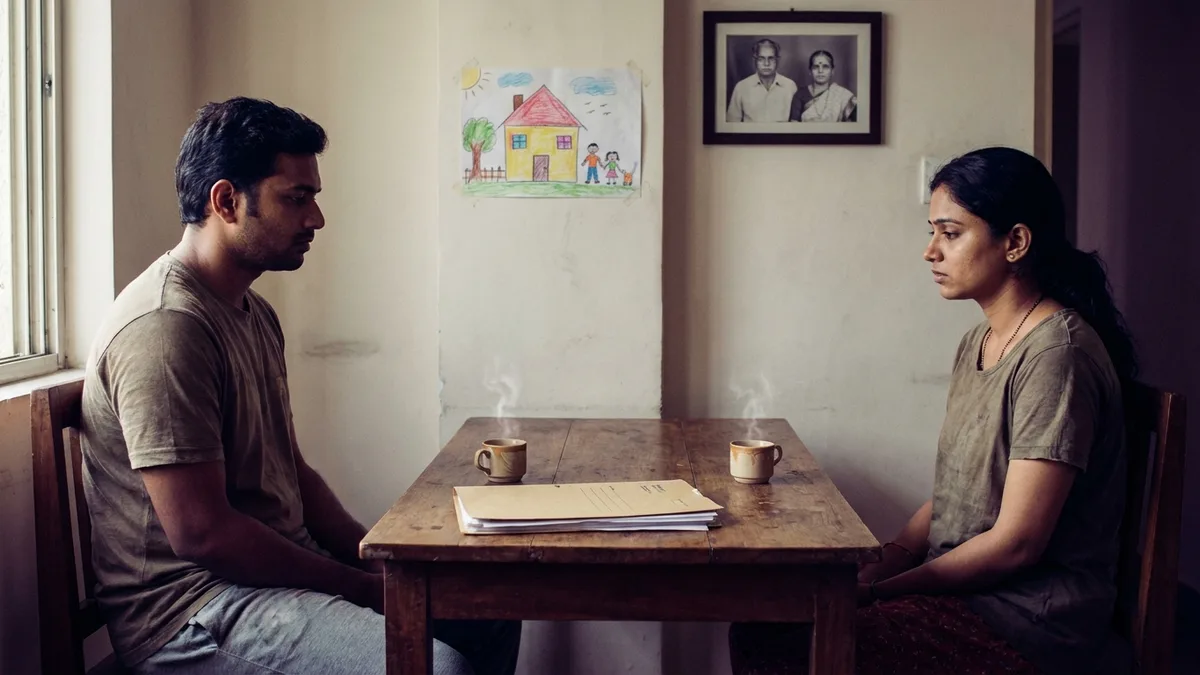
If you are reading this, you are probably somewhere hard. Maybe you have both known for a long time. Maybe one of you said it out loud last week and the other is still catching up. Maybe there is a child asleep in the next room and two sets of parents who don't know yet.
You will need to think clearly about money, your children and what to tell your families, often while feeling numb. It helps to have somewhere to think out loud. Adoree is an AI relationship assistant each of you can talk to privately, by voice or text, at any hour. You can work out what you want, what you are afraid of, and how to say it to your partner, your parents or your in-laws, before you say it for real.
This is general information, not legal advice. Divorce law depends on your facts and your personal law, so speak to a family lawyer or your District Legal Services Authority.
Mutual divorce process in India, step by step
The process has two court hearings, called motions, with a waiting period between them. First you file together and record your statements. Then, between six and eighteen months later, you both confirm you still agree. If the court is satisfied, it grants the decree of divorce.
The rules below come from Section 13B as quoted by the Supreme Court in Amardeep Singh v. Harveen Kaur (2017) and from Section 28 of the Special Marriage Act.
| Stage | What happens | Timing |
|---|---|---|
| Before filing | You live separately and settle the terms | At least 1 year of separation |
| First motion | Joint petition filed, statements recorded | Day 0 |
| Cooling period | Time to reconsider | Usually 6 months, can be waived |
| Second motion | You both confirm you still agree | Between month 6 and month 18 |
| Decree | Court grants divorce if satisfied | At or after the second motion |
1. Settle first, file second. Before a lawyer drafts anything, agree on alimony or maintenance, the return of jewellery and stridhan, the house and any loans, and where the children will live and how often they will see the other parent. A genuine, complete settlement is also one of the things a court checks before waiving the cooling period, and an issue left open can stall the whole process.
2. File the joint petition (first motion). It goes to the family court, which is where mutually consenting couples normally go, as the Supreme Court Observer explains. Both of you sign it and appear to record your statements.
3. The cooling period. The second motion can be made "not earlier than six months" after the first and "not later than eighteen months" after it. The Supreme Court described this period as time "to enable the parties to have a rethink".
4. Second motion and decree. You both appear again and confirm. The law lets the court act on the second motion only "if the petition is not withdrawn in the meantime", so either of you can still stop it before then.
Can the mutual divorce cooling period be waived?
Yes. In Amardeep Singh v. Harveen Kaur (2017), the Supreme Court held that the six-month period in Section 13B(2) is directory, not mandatory. A family court can waive it if four conditions are met, and you can apply for the waiver one week after the first motion.
The four things the court considers:
| Condition | What it means for you |
|---|---|
| Time already served | Your one year of separation and the six months have both passed before you file |
| Reconciliation has failed | Mediation or conciliation was tried and there is no real chance it will work |
| Everything is settled | Alimony, custody of children and other pending issues are genuinely agreed |
| Waiting only hurts | The wait would only prolong your distress |
In practice that means a couple who separated eighteen months or more before filing, and who arrive with a complete settlement, has a strong case for a waiver. A couple who separated fourteen months ago and still disagree about the flat does not.
The same judgment says the court can use video conferencing, and can permit representation through close relatives such as parents or siblings, when a spouse cannot attend in person. That matters if one of you now lives in another city or abroad.
What changed in 2023: Shilpa Sailesh v. Varun Sreenivasan
On 1 May 2023 a Constitution Bench of the Supreme Court decided Shilpa Sailesh v. Varun Sreenivasan. It held that the Supreme Court can use its power under Article 142 to dissolve a marriage, including on the ground of irretrievable breakdown. As a CMR University case commentary summarises, the Court said it can grant a consenting couple a divorce without the Section 13B waiting period, and that couples cannot ask for this directly through a writ petition under Article 32.
For most couples, this does not change the everyday route. You still start in the family court. The judgment matters mostly for cases already before the Supreme Court.
Documents you will usually need
The law itself doesn't publish a single checklist, and requirements vary by court. Lawyers commonly ask for the documents below, as listed by practitioners such as Sansa Legal and Advocate Gandhi.
- Proof of marriage: marriage certificate, and wedding photographs and invitation if you have them
- Identity and address proof for both of you, such as Aadhaar or passport
- Proof that you have lived separately for a year or more
- Income details, such as salary slips or income tax returns
- Details of property, savings and loans
- Details of your children
- The written settlement: alimony, stridhan, property and custody terms
Mutual divorce timeline and costs
Most mutual divorces in India take between six and eighteen months from the first motion, because of the statutory window. With a waiver it can take far less. Costs vary widely: court fees are set by each state, and the biggest cost is usually the lawyer.
| Scenario | Likely timeline from filing |
|---|---|
| Full cooling period, everything settled | Roughly 6 to 8 months |
| Cooling period waived | Roughly 1 to 2 months |
| A term reopened mid-way | Up to the 18-month limit, or the petition fails |
These timelines are practitioner estimates from Advocate Gandhi and Rest The Case, not rules. We have not found a reliable national figure for costs, so ask two or three lawyers for a written quote that says what is included.
Under Section 12 of the Legal Services Authorities Act, a woman or a child is entitled to free legal services. Your District Legal Services Authority can help, and NALSA's helpline is 15100.
How to talk about mutual divorce with each other
Have the conversation somewhere private, when neither of you is rushing out, and start with what you both want for the next few years rather than with what went wrong. You are not trying to win this one. You are trying to finish it with as little damage as possible to two people and possibly some children.
If you are the one raising it:
"I've been thinking about this for a long time, and I don't think either of us is happy. I'd like us to talk about separating properly, by mutual consent, so neither of us has to fight in court. I don't need an answer tonight."
If you are the one hearing it:
"I'm not ready to agree to anything yet. I need a few days. Can we set a time on Sunday to talk again?"
Then agree on a few ground rules before you get to money or children:
- One topic per conversation. Alimony on one day, the children on another.
- No discussing it in front of the children, or on the family group.
- Either of you can pause, as long as you say when you'll come back to it.
Fights will still happen. The guide on how to calm down after a fight helps for the twenty minutes after one.
Each of you can also talk it through with Adoree in your own private conversation first. Saying the hard sentence once, to someone who won't react, makes it easier to say it calmly to your spouse.
Telling your parents and in-laws
Tell your own parents yourself, before they hear it from anyone else, and agree with your spouse on one simple version of why. In many Indian families, both sets of parents will feel the divorce as their own loss, and they may push for one more try. That comes from love, even when it doesn't feel like it.
Agree on the shared line first, together:
"We've both decided, after a long time, that we can't make this marriage work. It's a joint decision. We're doing it by mutual consent and we're trying to keep it respectful."
To your own parents:
"I know this is hard to hear and you'll want to fix it. We've already tried. What I need from you now is support, not a meeting with the elders."
To your in-laws, if you are still close:
"You have been family to me and I'm grateful for that. This is between your son and me, and I'll always respect you, and you will always be part of the children's lives."
If your families keep pushing, repeat the shared line rather than defending your reasons. Every new reason you give becomes something to argue with. Adoree can help you plan these talks, including what to say if a parent cries, gets angry, or calls a relative in.
Children and mutual divorce
Tell your children together, in simple words suited to their age, and keep telling them the same two things: this isn't their fault, and both of you will keep loving them and showing up. Your custody and visiting arrangement will be part of your settlement, so build it around their school, their routine and their bond with both of you.
A script for younger children:
"Mumma and Papa have decided to live in two homes. That's a grown-up decision, and it's not because of anything you did. You'll still see both of us a lot, and we both love you exactly the same."
For teenagers, give more of the truth and more say: "We'd like to hear what matters to you about where you stay and when." Never ask a child to carry messages, choose a side, or keep a secret from the other parent. If grandparents are involved in daily care, tell them the plan too, so the children hear one story from everyone.
Not sure yet? Before you file
If one or both of you is unsure, you don't have to decide this month. The cooling period exists for exactly this, and plenty of couples use the time before filing to try once more with clear eyes.
A few honest questions to ask yourself:
- Is this a hard season, or has it been the same for years?
- Have we ever tried with real help, or only tried harder on our own?
- Am I leaving the marriage, or leaving a version of it that could change?
Couples counselling with a professional can help you decide either way, and our guides to couples therapy and counselling cover how it works. If the feeling is more of drift than of an ending, how to fix a relationship is a good place to start. Adoree can also help each of you think it through privately first, so that when you talk, you are both saying what you actually mean.
If there is violence, threats or harassment in your marriage, put safety ahead of any process. In an emergency call 112, India's Emergency Response Support System. The Women Helpline 181 runs 24x7 and connects women with police and support services, according to the government. If you are struggling to cope, Tele-MANAS is free on 14416.
Ending it with care
A mutual divorce is still a loss, even when it is the right decision. What you control is how you go through it: settled before you file, honest with your families, steady for your children. Do those three things and the court part becomes mostly paperwork.
If you want to plan what to say, to each other or to your parents, Adoree is there any time, by voice or text. More guides written for couples in India are on Adoree India.
Frequently asked questions
How long does a mutual divorce take in India?
Usually between six and eighteen months from filing, because the second motion cannot normally be heard sooner than six months after the first. If the court waives the cooling period, it can be much quicker. Court schedules in your city, and whether every term is already settled, make the biggest difference.
Is the six-month cooling period in mutual divorce mandatory?
No. In Amardeep Singh v. Harveen Kaur (2017) the Supreme Court held it is directory. A court can waive it when the year of separation and six months have already passed before filing, mediation has failed, alimony and custody are settled, and waiting would only prolong the couple's distress.
Can mutual divorce happen in one month?
Sometimes, but only if the family court agrees to waive the cooling period. Amardeep Singh allows a waiver application one week after the first motion. Whether it is granted depends on your facts, especially how long you have already lived apart and whether every issue is settled.
What happens if one spouse withdraws consent before the second motion?
The court acts on the second motion only if the petition has not been withdrawn in the meantime and both parties make that motion. If one of you withdraws, a mutual consent decree cannot follow. The other spouse would need to consider a contested divorce on the grounds the law allows.
Do both spouses have to appear in court for mutual divorce?
Generally yes, because the court needs to hear both of you. In Amardeep Singh the Supreme Court said family courts can use video conferencing, and can allow representation through close relatives such as parents or siblings, when a spouse cannot attend in person.
How much does a mutual divorce cost in India?
There is no fixed national figure. Court fees are set by each state, and most of the cost is usually the lawyer's fee, which varies by city and by how much needs settling. Ask two or three lawyers for a written quote. Women are entitled to free legal services through the Legal Services Authorities.
Which law applies to mutual divorce in India?
It depends on how you married. Marriages under the Hindu Marriage Act use Section 13B. Marriages under the Special Marriage Act use Section 28, which has the same one-year separation rule and the same six to eighteen month window. Other personal laws have their own rules, so check with a lawyer.
Think it through before you say it.
Whether you're deciding, or planning how to tell your families, talk to Adoree privately by voice or text, any hour. Each of you gets your own conversation.
Talk to Adoree →Ask Adoree
Wondering whether to stay or go? Tell me where things are — I'll help you see it clearly.
More on this: Love, marriage and family in India, every guide in one place →
References
- Amardeep Singh v. Harveen Kaur (2017), Civil Appeal 11158 of 2017, Supreme Court of India. LegalAuthority (full judgment text). https://www.legalauthority.in/judgement/amardeep-singh-vs-harveen-kaur-963
- Supreme Court's Power To Directly Grant Divorce (Shilpa Sailesh v. Varun Sreenivasan, 2023). Supreme Court Observer. https://www.scobserver.in/cases/supreme-courts-power-to-directly-grant-divorce/
- Case Commentary: Shilpa Sailesh v. Varun Sreenivasan. CMR University School of Legal Studies. https://www.cmr.edu.in/school-of-legal-studies/journal/wp-content/uploads/2025/09/Case-Commentary-Shilpa-Sailesh-Versus-Varun-Sreenivasan-2023-3-MLJ-617-LNIND-2023-SC-325.pdf
- Special Marriage Act, 1954, Section 28: Divorce by mutual consent. AdvocateKhoj bare act. https://www.advocatekhoj.com/library/bareacts/specialmarriage/28.php
- Legal Aid: who is entitled to free legal services. National Legal Services Authority (NALSA). https://nalsa.gov.in/legal-aid/