
adoree Ask me in one tap
Key takeaways
- Micro cheating means small acts that feel like a breach of trust without being a physical affair. The word is subjective, so couples often disagree about what counts.
- Secrecy is the clearest marker. If you would change the behavior because your partner is watching, it is worth a conversation.
- Americans split sharply on the grey areas: 42% call flirting infidelity, while 76% say a secret emotional relationship is cheating (iFidelity Survey, 2019).
- Couples have to define their own line together. Rules imposed by one partner tend to breed resentment and snooping.
- The worried partner does best naming one specific behavior and one feeling. The accused partner does best getting curious before getting defensive.
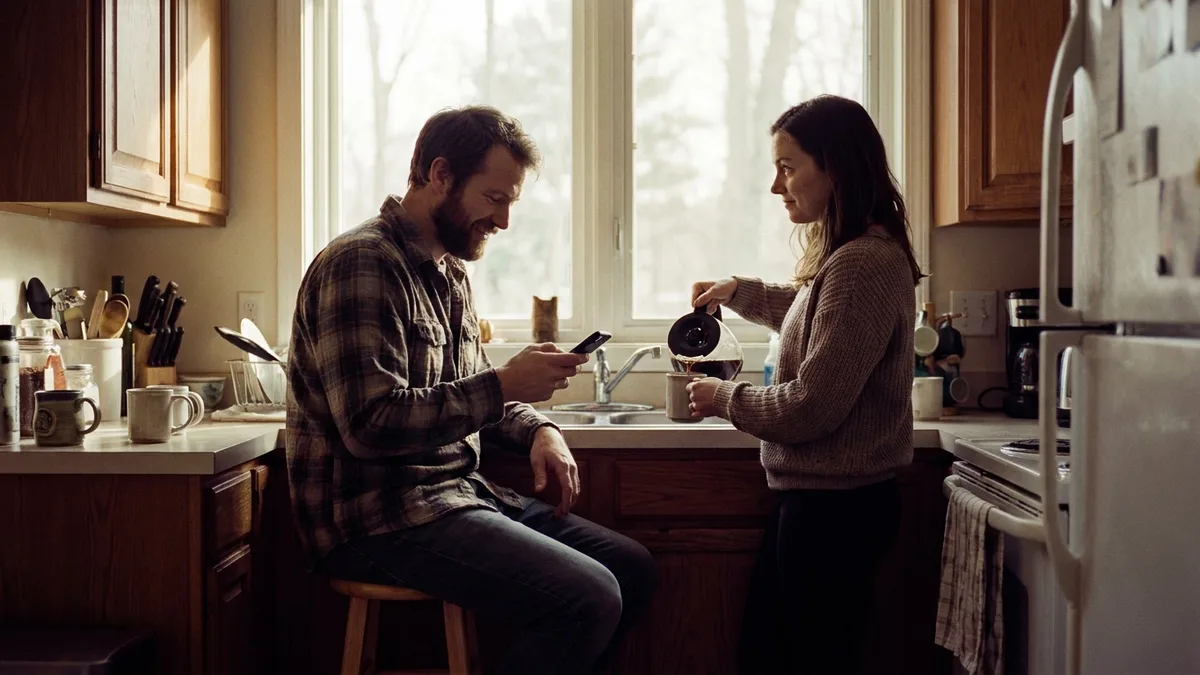
Micro cheating is the name for small things that feel like a betrayal even though nothing "happened." A text thread that gets deleted. A dating app that never quite got uninstalled. A coworker saved in the phone as "Dave IT" when there is no Dave.
None of these is an affair. That is exactly why they are so hard to talk about. One of you feels a sting you can't fully justify. The other feels accused of something that isn't a crime. Both of those feelings are real.
This guide covers what micro cheating is, real examples, the grey areas couples argue about most, and what to actually say, whichever side of the conversation you are on.
If you can't tell yet whether you are overreacting or underreacting, talk it through before you talk to your partner. Adoree is an AI relationship assistant you can talk to privately, by voice or text, at any hour. You can lay out what happened, sort the feeling from the facts, and rehearse your opening line until it sounds like you and not like an accusation.
What is micro cheating?
Micro cheating is a pattern of small actions that suggest someone is emotionally or physically focused on a person outside their relationship, without a physical affair. Think secret DMs, flirting, a hidden contact or an active dating profile. The marker is usually secrecy: the behavior changes, or disappears, when the partner is watching.
Back in 2017, dating expert Melanie Schilling described micro cheating to HuffPost Australia as a series of seemingly small actions showing a person is focused on someone outside the relationship. Psychology Today frames it as small breaches of trust that don't cross into a physical affair, and notes the obvious problem: what one person calls micro cheating, another calls completely fine.
That subjectivity is the whole story. "Microcheating" is not a clinical term and there is no official list. There is only the line two specific people have agreed on, or more often, the line they assumed they agreed on.
Micro cheating examples
These come up again and again when couples describe what hurt:
- Hidden threads. Deleting messages, muting a chat, or turning the phone face down when one name lights it up.
- The fake contact name. Saving someone under a decoy so the notification looks innocent.
- The dating app "just to look." An active profile, or an app kept installed "out of habit."
- Downplaying the relationship. Not mentioning a partner to someone you find attractive, or calling it "casual" when it isn't.
- The favorite person. Always replying to one person's stories, liking their old photos, messaging them after hours.
- Confiding first. Telling a work friend about a fight, or good news, before telling your partner.
- Dressing for someone. Making a particular effort only on the days a certain person will be there.
Notice what most of these share. The act itself is ordinary. Liking a photo is ordinary. What turns it into something is a person, a pattern and a reason to hide it.
What counts as micro cheating? Where's the line
What counts as micro cheating depends on what the two of you have agreed, but a useful rough guide is this: the same behavior can be fine, grey or clearly over the line depending on secrecy, frequency and intent. Here is how the most common behaviors tend to land, with survey data where it exists.
| Behavior | Usually fine when | Starts to sting when | What Americans say |
|---|---|---|---|
| Liking photos | Friends, family, everyone | One person, suggestive photos, late at night | No good survey data |
| DMs and story replies | Group chats, open banter | Daily one-on-one, then deleted | No good survey data |
| Following an ex | Old news, no contact | Checking their profile, messaging | 16% "always cheating" (2017); 32% call it infidelity (2019) |
| Saved contact under a fake name | Never really fine | Always a sign of hiding | No good survey data |
| Dating app still installed | Deleted account, forgotten app | Active profile, opening it | 63% say an active profile is cheating (2017) |
| Flirting | Mutual, playful, in the open | One-on-one, escalating, hidden | 42% call it infidelity (2019) |
| Sexting someone else | Not applicable | Any time | 51% "always cheating" (2017) |
| Secret emotional bond | Not applicable | Any time | 76% call it cheating (2019) |
Sources: the 2017 figures come from a Deseret News survey run by YouGov of 1,000 nationally representative US adults. The 2019 figures come from the iFidelity Survey, fielded by YouGov among 2,000 US adults. The two surveys worded questions differently, so read them side by side, not as one scale.
Two things stand out. First, people genuinely disagree. Fewer than half of Americans call flirting infidelity, yet three in four call a secret emotional relationship cheating. Second, the iFidelity data found that flirting and following an old flame online were both linked to a higher chance of having an emotional affair, even though most people did not count them as cheating themselves. Small things are not nothing. They are also not proof.
Why couples have to define their own line
No article, including this one, can tell you where your line is. A couple who met at work and both stay friendly with exes will draw it in a different place from a couple where one partner was cheated on before. Neither is wrong.
The trouble starts when the line was never said out loud. One partner assumes "obviously you don't message your ex at midnight." The other assumes "obviously I can talk to an old friend." Then something happens, and both of you feel betrayed: one by the act, the other by a rule they never knew existed.
So make the agreement on purpose. Sit down when nothing is on fire and each answer these separately, then compare:
- Which of the behaviors in the table above would hurt me, and which wouldn't?
- What would I want to know about, even if it's harmless?
- What do I need from you around exes, dating apps and one-on-one messaging?
- What would make me feel trusted rather than watched?
Where your answers match, you have an agreement. Where they don't, you have the real conversation. Our guide to boundaries for opposite-gender friendships goes deeper on setting these without one of you becoming the rule-keeper.
How to talk about micro cheating
The conversation goes best when the worried partner leads with one specific thing and one feeling, and the accused partner leads with curiosity. Both of you are trying to protect the relationship. You are just protecting different parts of it: one of you is protecting the trust, the other is protecting the freedom to be yourself.
If you're the worried partner
Pick one behavior, not a case file. Say what you saw, how it felt and what you need. Leave out the verdict.
"I saw the messages with Sam were deleted, and my stomach dropped. I'm not saying something happened. I'm saying I need to understand it, because I don't want to feel like this."
"Can we talk about the dating app? I know it might be nothing. When I saw it still on your phone, I felt like I might be the backup plan."
"I don't need you to cut anyone off tonight. I need us to agree on what's okay with exes, because I think we have different ideas."
Avoid opening with "Who is she?" or "I knew it." It feels honest in the moment, but it forces your partner to defend themselves instead of hearing you.
And be careful with the phone. In a Pew Research Center survey, 34% of partnered adults said they had looked through a partner's phone without them knowing, while 70% of adults said doing so is rarely or never acceptable. Snooping can feel like the only way to get the truth, but whatever you find, you have to explain how you found it, and the conversation turns into a fight about privacy.
If you're the accused partner
Your first instinct will probably be "It's nothing" or "You're being paranoid." Even if it really was nothing, that response tells your partner their feeling doesn't count. Try curiosity first.
"Okay. I can hear that this really hurt. Tell me what it looked like from your side."
"You're right that I deleted them. I did it because I didn't want a fight, and I can see that hiding it made it look worse."
"I don't think I did anything wrong, and I also don't want you feeling like this. Can we work out together what's okay for us?"
If you honestly don't see the problem, you can say so. "I don't agree that liking a photo is cheating, and I want to understand why it bothered you" is fair. What is not fair is turning the conversation into a trial of your partner's insecurity.
Then ask yourself the uncomfortable question privately: what was the behavior giving me? Attention, novelty, a break from tension at home? That answer is useful to the relationship, whatever you decide to say about it.
What to do after the conversation
A good talk is the start. What happens in the next few weeks decides whether it worked.
| If you were worried | If you were accused |
|---|---|
| Watch what happens over weeks, not one night | Do what you agreed without being asked twice |
| Name it when your partner follows through | Offer openness before it is requested ("Sam texted, here's what it was about") |
| Bring new worries up early, kindly | Ask what would help trust come back faster |
| Notice if checking becomes a habit you want to stop | Put the energy you were spending elsewhere back home |
If the same behavior keeps happening after you both agreed on a line, you are no longer dealing with a misunderstanding. That is a choice, and it is fair to treat it as one. If small things have grown into a deep secret bond, read our guide to emotional cheating, and the trust and cheating hub for rebuilding.
One more line worth drawing: checking in is different from control. If a partner demands every password, tracks your location without agreement, or you feel afraid to say no, that is about control and safety. The National Domestic Violence Hotline is at 1-800-799-7233.
How Adoree helps with micro cheating
Most micro cheating fights go wrong in the first thirty seconds, before either person has worked out what they actually feel. That is where Adoree helps. Each of you can talk to Adoree on your own, privately, by voice or text. You can describe what you saw, figure out whether the sting is about this person or something older, and practice saying it in a way that invites an answer instead of a defense.
Adoree hears both sides separately and holds both as valid. When you are ready, Adoree can help the two of you agree on a line you both chose. More on how that works is on our about page.
Talk to Adoree before the conversation, so the conversation can go better.
Frequently asked questions
What is micro cheating?
Micro cheating is a set of small actions that suggest someone is emotionally or physically focused on a person outside their relationship, without a physical affair. Typical examples are secret messaging, flirting, saving a contact under a fake name or keeping a dating profile active. What makes it feel like betrayal is usually the secrecy.
What are examples of micro cheating?
Common examples include hiding or deleting a text thread, saving someone under a fake name, keeping a dating app active while committed, regularly flirting with one person, downplaying your relationship to someone you find attractive, and confiding relationship problems to that person before your partner. A single act is rarely the issue. A pattern is.
Is liking pictures micro cheating?
Usually not on its own. Liking a friend's photo is normal social media use. It starts to sting when it is one particular person, it is repeated, it is suggestive content, or it happens late at night and gets hidden. Talk about the pattern and how it makes you feel rather than the single like.
What is the difference between micro cheating and emotional cheating?
Micro cheating describes small boundary-crossing behaviors, like flirty DMs or a hidden contact. Emotional cheating is a deeper bond where someone outside the relationship becomes a main source of intimacy and support, usually kept secret. Micro cheating can be a step toward an emotional affair, but it does not always lead there.
Is micro cheating a red flag?
It is a signal, and how your partner responds matters more than the act. A partner who listens, explains and adjusts is showing care. A partner who hides more, mocks the concern or keeps repeating the behavior after you agreed on a line is showing you a bigger problem.
Is texting an ex micro cheating?
It depends on the agreement you have and how it happens. Practical co-parenting or an occasional open check-in is different from late-night messages you would not want your partner to read. If you delete the thread or avoid mentioning it, treat that as your answer and raise it.
How do I stop micro cheating?
Notice what the behavior gives you: attention, novelty, reassurance or escape from tension at home. Stop the hidden part first, then tell your partner what you noticed. Agree on what you both want around exes, DMs and apps, and put the need you were meeting elsewhere back into the relationship.
Say it once before you say it for real.
Talk it through privately with Adoree by voice or text, any hour. Find the words, hear how they might land, then have the conversation.
Talk to Adoree →Ask Adoree
Trust shaken? Tell me what happened — I'll help you see what rebuilding it actually takes.
More on this: Words of modern love, every guide in one place →
References
- What counts as cheating in marriage? Emotional infidelity in a national sample (iFidelity Survey). Jeffrey Dew, Institute for Family Studies (2024). https://ifstudies.org/blog/what-counts-as-cheating-in-marriage-emotional-infidelity-in-a-national-sample
- Deseret News survey looks at what counts as infidelity and adultery in the digital age. Deseret News / YouGov (2017). https://www.deseret.com/2017/4/13/20496409/news-release-deseret-news-survey-looks-at-what-counts-as-infidelity-and-adultery-in-the-digital-age
- Dating and Relationships in the Digital Age. Pew Research Center (2020). https://www.pewresearch.org/internet/2020/05/08/dating-and-relationships-in-the-digital-age/
- Micro-cheating: what is it and does it count?. HuffPost Australia (2017). https://www.huffpost.com/archive/au/entry/2017/08/15/micro-cheating-what-is-it-and-does-it-count_a_23077600/
- Micro-Cheating. Psychology Today. https://www.psychologytoday.com/us/basics/micro-cheating