
Key takeaways
- Research shows LDR couples often report equal or higher intimacy than geographically close couples, because distance makes communication intentional.
- Obligatory daily check-ins breed resentment. Contact driven by genuine desire to connect works better.
- A concrete timeline for closing the distance is one of the strongest predictors of whether an LDR survives.
- About one-third of LDR couples break up within three months of finally living in the same place, so planning the transition matters as much as surviving the gap.
- Each partner managing their own emotional life, not just depending on calls for regulation, reduces pressure and keeps the relationship healthier.
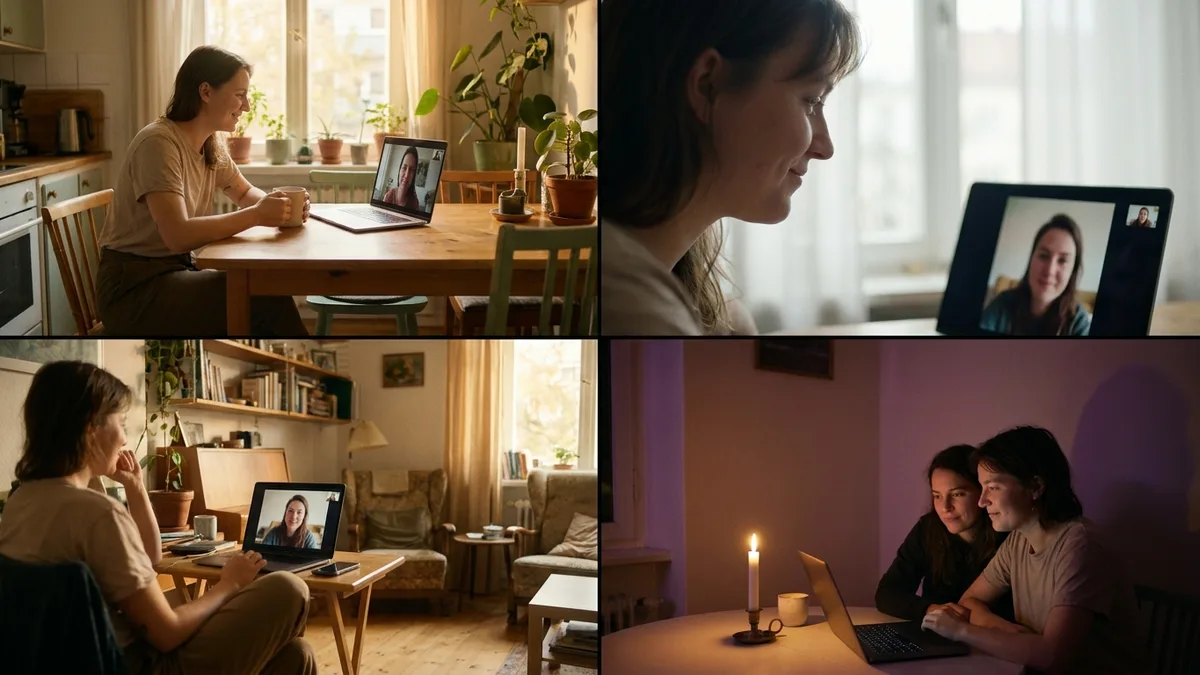
Long distance is hard in a specific, quiet way that is difficult to explain to people who haven't done it. It is not dramatic. It is the 7 p.m. call when neither of you has much to say, or the weekend when your plans fall through again, or the slow realization that you've been imagining their life instead of knowing it.
But it is also survivable. More than survivable. A 2013 study in the Journal of Communication found that LDR couples reported equal or higher intimacy than geographically close couples, largely because their communication had to be intentional. When you only have words and a screen, you get more direct about what matters.
Here's what actually works.
Does Distance Kill Relationships?
No. But silence does, and so does the absence of a plan.
Research by Jiang and Hancock (2013) found that long-distance couples engaged in more self-disclosure per conversation than geographically close couples. They shared more of what was actually happening inside them because small talk doesn't travel well across 500 miles. That depth became a real source of intimacy.
What the data also shows: around 58% of long-distance relationships end in long-term commitment. That number is comparable to relationships that start with both people in the same city. The variable is not the distance. It is whether both people are building toward the same thing.
The Single Most Important Move: Have a Plan
If you take nothing else from this, take this: a relationship without a convergence plan does not survive long distance well.
A convergence plan does not need to be detailed or permanent. It needs to be real. A city you're both willing to consider. A rough timeline. Some concrete step that shows the distance is temporary, not the default state.
Without it, the LDR stops feeling like a phase and starts feeling like a life. That is when one partner starts quietly calculating whether the investment makes sense, and the other starts sensing the doubt, and the whole thing frays from the inside.
Research consistently identifies having a shared vision for the future as one of the strongest predictors of LDR success. The plan is not about locking anything in. It is about being able to say "we're going somewhere" and both mean it.
How to Communicate Without Burning Out
Here's the mistake a lot of LDR couples make: scheduling contact as if frequency is the measure of commitment.
It is not. Mandatory daily check-ins, when you have nothing to say or you're exhausted or you just need a quiet evening, breed resentment. You start dreading the call. The call becomes evidence that you're a bad partner if you miss it. The relationship starts to feel like an obligation, and that feeling spreads.
What works better is contact that comes from wanting to connect, not obligation to check in. Some couples talk twice a day. Some talk twice a week. The right frequency is the one that both people genuinely want.
| Communication trap | What works instead |
|---|---|
| Daily calls that feel mandatory | Contact when you actually want to connect |
| Constant texting to manage anxiety | Texting to share something real |
| Keeping score of who reaches out more | Expressing directly when you need more |
| Avoiding hard topics until a visit | Addressing friction as it comes up, remotely |
The other thing: address tension when it happens, not when you finally see each other. Saving difficult conversations for in-person visits turns every reunion into a conflict session and poisons the time you actually have together. It is possible to have hard conversations on a call. Not easy, but possible.
Managing the Psychological Distance
Physical distance creates an information gap that imagination fills in, usually badly.
When you don't know what your partner's day actually looked like, your brain invents a version. When they don't text back for three hours, you write a story. When they seem a little flat on a call, you spiral. This is how jealousy and insecurity grow in LDRs, not from anything your partner is doing, but from the stories you tell in the absence of information.
Two things help:
First, share specifics. Not just "I had a long day." The table you're sitting at, the person you spoke to, the thing that made you laugh. Specificity creates shared context. Without it, you're each imagining a version of the other's life that drifts further from reality over time.
Second, develop your own emotional life. Partners who rely entirely on calls for emotional regulation put enormous pressure on every interaction. When the call is slightly off, the whole week feels off. Having your own friendships, routines, and activities means you arrive at calls as a person, not a need.
Staying Connected Without Being There
You don't have to be in the same room to have shared experiences. You just have to be intentional about creating them.
A few things couples actually report working:
- Watching a film or series at the same time on a call
- Cooking the same recipe on the same evening
- Sending something physical, a letter, an object, something that travels
- Playing a game together online
- Sharing one photo from the day, every day, without commentary required
None of these replace physical presence. But they create texture. They give you something to refer back to, something that's yours together and not just adjacent.
For couples navigating distance with ongoing tension or communication breakdowns, Adoree can help each partner work through what they're experiencing privately, then offer both people a clearer picture of what the dynamic actually looks like. This is especially useful when conversations over video feel like they escalate faster than they would in person, because there is no body language, no shared space, nothing to absorb the charge.
The Transition Period Is Its Own Risk
Here is something most LDR advice skips: closing the distance is its own difficult phase.
About a third of long-distance couples break up within three months of finally living in the same place. The reasons are not mysterious. They built a relationship in controlled doses. Visits were curated. Calls were intentional. Then they're suddenly navigating laundry and moods and the fact that the other person exists at 7 a.m. before coffee, and the idealized version they each carried cracks against daily reality.
This does not mean the distance was fake. It means the transition needs its own attention.
| LDR phase | Core challenge |
|---|---|
| Early LDR | Establishing communication rhythms and trust |
| Mid-LDR | Preventing drift, keeping plans concrete |
| Closing the distance | Adjusting from curated to daily, managing expectations |
| Post-LDR | Rebuilding shared routines without the structure of scheduled contact |
Give the transition time. Expect friction. The friction is not a sign it was all wrong. It is the ordinary difficulty of two lives merging after running in parallel.
What the Research Says About Intimacy and Distance
The Jiang and Hancock study is worth dwelling on because it runs counter to what most people assume.
In their research, LDR couples:
- Self-disclosed more in each conversation
- Reported higher perceived partner responsiveness
- Rated their overall intimacy as equal to or higher than geographically close couples
The explanation is intuitive once you hear it: when you cannot rely on physical proximity, touch, or spontaneous shared experience, you have to build intimacy through words. And intentional communication, even at lower frequency, builds real closeness.
This does not make distance easy. But it does mean that couples who treat the distance as an obstacle to survive are missing something: the discipline of intentional communication is a skill that serves the relationship long after the miles disappear.
A Note on When Distance Becomes Too Much
Long distance works when both people are genuinely committed and the timeline is real. It does not work as a holding pattern for a relationship that was already in trouble, as a way to avoid conflict, or when one person is building a life in a direction the other isn't included in.
If you are in a long-distance relationship and something feels off, the answer is not to call more. It is to name what you're actually sensing. The conversation that feels too hard to have over video is usually the one that most needs to happen.
If you and your partner keep circling the same tension without resolving it, Adoree lets each of you share what you're really experiencing privately. Distance makes it especially hard to hold both sides of a conflict at the same time. Adoree does that work so you don't have to figure it out alone.
The miles between you are just miles. What keeps couples together is the same thing that always has: honest conversation, a shared future, and the willingness to say the thing they'd rather not say.
Frequently asked questions
Can long distance relationships actually survive?
Yes. Research published in the Journal of Communication (Jiang and Hancock, 2013) found LDR couples reported equal or greater intimacy than geographically close couples. Around 58% of long-distance relationships end in long-term commitment. The primary predictors are having a convergence plan and communicating with intention, not volume.
How often should you communicate in a long distance relationship?
There is no universal right answer. What works is the frequency both partners genuinely want, not a schedule that feels like an obligation. Couples who over-communicate out of anxiety often report more conflict. Aim for contact that feels connecting, not checking-in out of fear.
What causes most long-distance relationships to fail?
The most common reasons LDRs end are lack of physical intimacy (cited by 66% of couples in surveys), fear of growing apart, poor communication quality, and the absence of a plan for eventually living together. Notably, about a third of LDR couples break up within three months of closing the distance, suggesting the transition itself is a high-risk period.
How do you stay emotionally connected across distance?
Intentional self-disclosure, sharing what is actually happening in your inner life and not just logistics, is one of the strongest predictors of intimacy across distance. Watching the same film, cooking the same meal, or sending something physical also creates moments of shared experience without requiring physical presence.
How important is having an end date for a long distance relationship?
Very. Relationships without a concrete plan for closing the distance tend to drift. Both partners need a shared vision: a location, a rough timeline, and some demonstrated action steps. The plan does not need to be perfect, but it needs to exist. Without it, the distance can start to feel permanent.
What is the hardest part of a long distance relationship?
Most couples identify physical intimacy as the hardest part. But what comes up in research and therapy is often the asymmetry: two people in different environments, with different daily stresses, trying to emotionally stay in sync without shared context. The gap between how you imagine their life and how it actually is grows quietly, and jealousy or disconnection follows.
Meet Adoree.
Adoree is an AI relationship assistant built for couples. It hears both partners privately, remembers everything, and helps you actually move forward. Free for 3 days.
Try Adoree free →Your version of this
You just read about the pattern. Tell me yours — I’ll tell you which one you’re in.
Three messages, free, no sign-up. Nothing is saved unless you keep it.
References
- Absence Makes the Communication Grow Fonder: Geographic Separation, Interpersonal Media, and Intimacy in Dating Relationships. Jiang & Hancock, Journal of Communication (2013). https://academic.oup.com/joc/article/63/3/556/4085972
- How to make a long-distance relationship work. Psyche.co (research-backed guide). https://psyche.co/guides/research-backed-tips-for-making-a-long-distance-relationship-work
- The 2026 Report: Key Statistics on Long Distance Relationships. Explore with Erin. https://explorewitherin.com/the-2026-report-key-statistics-on-long-distance-relationships/
- How to Survive a Long Distance Relationship. Mark Manson. https://markmanson.net/long-distance-relationships