
Key takeaways
- The exercise prioritizes understanding over persuasion. The listener's job is to fully receive the speaker's perspective, not to prepare a rebuttal.
- Speakers use 'I' statements and frame needs positively. Listeners take notes, ask clarifying questions, and summarize until the speaker confirms they felt heard.
- A randomized controlled trial of 72 couples found the Gottman approach reduced demand-withdraw communication by 51 to 65% and mutual avoidance by 60 to 62%.
- The exercise works best before a conversation escalates, not mid-argument. Use it when a topic is important enough to deserve real attention.
- The biggest mistake couples make is rushing the response. Comprehension before rebuttal is the whole point.
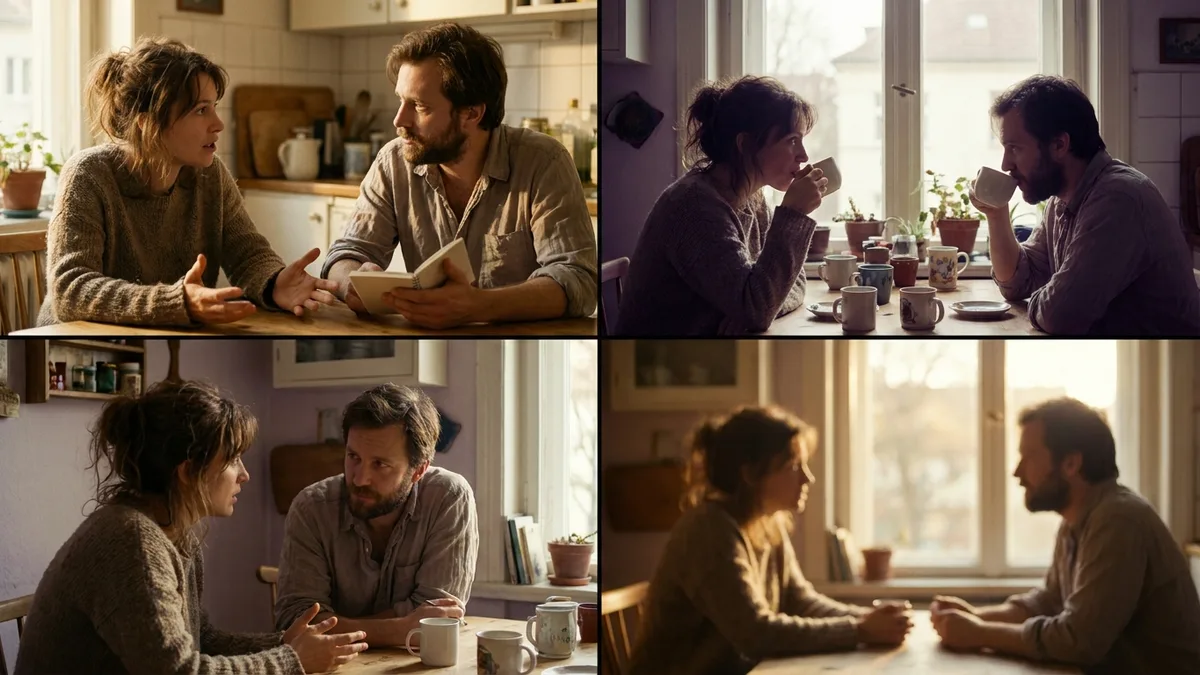
Most couples think they are listening when they are actually waiting. Waiting for a pause, waiting to respond, waiting for the moment to make their point. The Gottman-Rapoport technique interrupts that pattern, not by making you a better talker but by making you a better receiver.
The Gottman-Rapoport intervention is one of the more specific tools in the Gottman Method. It has a structure, a sequence, and a defined purpose. Here is what it actually is, how to use it, and what the research shows about why it works.
What is the Gottman-Rapoport intervention?
The Gottman-Rapoport intervention is a structured listening exercise designed to help couples genuinely understand each other's perspective on a topic they disagree about. One partner speaks for up to 20 minutes. The other listens, takes notes, asks clarifying questions, and summarizes. Then they swap.
The point is not agreement. Not problem-solving. Not compromise. Understanding. Everything else comes later, and it tends to come more easily once both people feel genuinely heard.
Drs. John and Julie Gottman adapted this technique from the work of Anatol Rapoport, a mathematical psychologist whose research on conflict showed that understanding two opposing positions accurately is a prerequisite for resolving them. The Gottmans applied that principle to couples in conflict.
The origin: Anatol Rapoport and two valid realities
Anatol Rapoport (1911-2007) was a Russian-born American mathematician and psychologist who spent decades studying game theory, conflict resolution, and the logic of how disagreements escalate. His central insight for interpersonal conflict: two people arguing usually hold two valid, internally consistent subjective realities. The problem is not that one person is right and the other is wrong. The problem is that neither person has fully understood the other's reality.
John Gottman built his intervention around this idea. In four decades of research observing couples in a lab setting, Gottman found that the couples who stayed together were not the ones who agreed more or fought less. They were the ones who could hold both realities at once, able to understand their partner's perspective without immediately dismantling it.
The Gottman-Rapoport technique operationalizes that capacity. It gives couples a structure for holding two realities in the same room.
How the exercise works, step by step
The Gottman-Rapoport exercise assigns one partner the role of speaker and the other the role of listener, then switches. The speaker talks uninterrupted for up to 20 minutes. The listener takes notes and summarizes until the speaker confirms they felt heard. Then the roles reverse. The structure is simple; staying in it is the work.
| Role | Rules | Goal |
|---|---|---|
| Speaker | Use 'I' statements only; no blame, criticism, or contempt; express feelings and positive needs; speak for up to 20 minutes without interruption | To be fully understood |
| Listener | Suspend judgment; take notes; ask clarifying questions only (not rebuttals); summarize what you heard; keep going until speaker confirms they felt understood | To understand, not to respond |
Setup: Choose a topic you genuinely disagree about. Agree on who speaks first. Take a breath. The listener should have something to write with.
Speaker's turn (up to 20 minutes): The speaker talks about the topic from their perspective: not the argument, not who was right, but their experience of it. What they need. How it feels. What they want the listener to understand. No "you always" or "you never." Only "I feel," "I need," "I want."
Listener's turn (same 20 minutes): The listener does not interrupt, disagree, or correct. They take notes. When the speaker finishes, the listener summarizes what they heard: not an interpretation, a reflection. Then they ask: "Did I get that right? Is there anything I missed?" The speaker clarifies. The listener summarizes again. This continues until the speaker says yes, that's right, I feel heard.
Swap roles. The listener becomes the speaker. The same rules apply. The exercise ends when both people have felt understood.
What the research actually shows
Most resources on the Gottman-Rapoport technique cite no empirical evidence. The actual research tells a different story. A randomized controlled trial published by the National Institutes of Health evaluated an online Gottman psychoeducational intervention with 72 couples (144 individuals), using a structured eight-session program based on Gottman's Sound Relationship House Theory. The study measured three communication patterns before and after, with follow-ups over 13 months.
| Communication pattern | Change for husbands | Change for wives |
|---|---|---|
| Constructive communication | +45% | +40% |
| Demand-withdraw communication | -51% | -65% |
| Mutual avoidance | -60% | -62% |
These are large effects, and they held at the one-year follow-up. The demand-withdraw pattern (where one partner pushes and the other retreats, a pattern that stonewalling research identifies as particularly corrosive) dropped by more than half.
The technique is not magic. It is structure applied to a situation where structure is genuinely useful: a conversation that matters, between two people who care, who keep talking past each other.
When to use the Gottman-Rapoport technique
The exercise is most effective before a conversation escalates, not after. Use it when a topic keeps recurring without resolution, when one partner consistently feels unheard, or when a significant decision needs both perspectives fully aired. It is not a tool for an argument already in progress.
| Good time to use it | Poor time to use it |
|---|---|
| A topic keeps coming up and never resolves | Mid-argument, when both partners are flooded |
| One partner feels consistently unheard | When one partner is not willing to participate |
| A big decision needs both perspectives | During a crisis that requires immediate action |
| Trust repair requires understanding each other's experience | When safety is the primary concern |
The exercise is not a crisis tool. It will not stop an argument that is already happening. What it can do is change the dynamic before the argument starts, by giving both people a real experience of being heard, which makes the next difficult conversation marginally less charged than the last one.
What tends to go wrong
Couples new to the Gottman-Rapoport technique consistently run into the same four problems. Knowing them in advance makes it substantially easier to stay in the structure when the conversation gets hard. The most common is the listener breaking role to defend or correct before the speaker has finished.
The listener starts defending. The moment a speaker says something the listener disagrees with, the urge to correct it is almost physical. The listener's job is to resist that urge entirely. Understanding does not require agreement. The summary is not a place to insert a counter-argument.
The speaker stops at the surface. The exercise is most useful when the speaker goes beyond the presenting complaint to the underlying need. "I want you to stop being on your phone at dinner" is a complaint. "I want to feel like I matter to you when we're in the same room" is the real thing.
Both partners rush. The structure exists for a reason. Twenty minutes is longer than most couples are used to giving each other uninterrupted. Sitting with that discomfort is part of what makes the exercise work.
They try it during an argument. The Gottman-Rapoport technique requires both partners to be calm enough to be in their prefrontal cortex, not their threat response. If a conversation is already escalating, the first move is a 20-minute pause, not the exercise.
Trying it with support
The exercise is learnable on your own. But having structure around it helps, particularly at the start. A couples specialist can facilitate the turns, prompt better questions, and notice when either partner slips back into debate mode.
An AI relationship assistant like Adoree works differently: it hears each partner separately, in their own private space, and helps each person articulate their perspective before they bring it to the conversation. That kind of preparation, knowing what you actually want to say before you try to say it, is often what the Gottman-Rapoport exercise is really building toward anyway. You can read more about how it works on the about page.
For more on the broader framework, the Gottman Card Deck app offers a free daily way to practice the underlying skills. And if lack of communication is the more immediate problem, that post covers the patterns that tend to develop before couples realize they have stopped talking.
The Adoree blog covers more of the specific tools and research behind what actually makes couples communication work.
If you want to understand what your partner has been trying to say, and to finally feel understood yourself, try Adoree free for seven days.
Frequently asked questions
What is the Gottman-Rapoport technique?
The Gottman-Rapoport technique is a structured communication exercise for couples. One partner speaks uninterrupted for up to 20 minutes while the other listens, takes notes, and summarizes. Then they swap roles. The goal is mutual understanding, not agreement or problem-solving.
Who was Anatol Rapoport and why does this technique carry his name?
Anatol Rapoport (1911-2007) was a Russian-born American mathematical psychologist known for game theory and conflict resolution. His key insight was that in conflict, two people often hold two valid subjective realities. Neither is simply wrong. Gottman built the technique around that principle.
How long does the Gottman-Rapoport exercise take?
Each speaker gets up to 20 minutes. With two partners and a brief transition between turns, a full session runs 45 to 60 minutes. Couples new to the exercise often find it useful to set a timer and stick to the structure even when it feels awkward at first.
What are the speaker's rules in the Gottman-Rapoport technique?
The speaker discusses the topic using 'I' statements, expresses their feelings and positive needs, avoids blame and criticism, and speaks for up to 20 minutes without interruption. The speaker's goal is to be understood, not to win the argument.
Can couples do the Gottman-Rapoport exercise on their own?
Yes. The structure is clear enough to practice independently. Many couples find it most productive to use it before a difficult conversation goes wrong, not after it already has. Having a framework, or a tool like Adoree that guides both partners through their perspectives separately, helps prevent the exercise from collapsing into an argument.
Meet Adoree.
Adoree is an AI relationship assistant built for couples. It hears both partners privately, remembers everything, and helps you actually move forward. Free for 3 days.
Try Adoree free →Your version of this
You just read about the pattern. Tell me yours — I’ll tell you which one you’re in.
Three messages, free, no sign-up. Nothing is saved unless you keep it.
References
- Evaluation of an Online Gottman's Psychoeducational Intervention to Improve Marital Communication among Iranian Couples. Salimi et al., National Institutes of Health, PubMed Central (2021). https://pmc.ncbi.nlm.nih.gov/articles/PMC8431023/
- Anatol Rapoport: Contributions to Game Theory and Conflict Resolution. Wikipedia (sourced from academic biographies). https://en.wikipedia.org/wiki/Anatol_Rapoport
- Gottman-Rapoport: An Intervention in Couples Therapy. Couples Therapy Inc.. https://couplestherapyinc.com/gottman-rapoport/