
Key takeaways
- Novelty beats effort. A 7-minute shared challenge can boost relationship quality more than an expensive routine night out (Aron et al., 2000).
- Consistency matters more than occasion. Couples who date regularly, even once or twice a month, report 56 to 114% higher odds of marital happiness (National Marriage Project, 2023).
- Dr. John Gottman recommends at least two hours per week of intentional, leisurely time together.
- The activities that build the most connection involve genuine attention: no phones, no passive streaming.
- Cooking together, creative projects, and conversation games outperform movies for real bonding.
Why date nights at home work (the science in 60 seconds)
The best fun date night ideas at home share one thing: novelty. A landmark study by Arthur Aron and colleagues found that couples who spent just seven minutes on a novel, mildly challenging task together reported greater relationship quality afterward than couples who did something pleasant but routine. The mechanism: new shared experiences activate the same dopamine-reward pathways that fire during early romance, briefly recreating that "falling in love" feeling without the early-relationship uncertainty.
You do not need a restaurant. You need genuine attention and something slightly unexpected.
The National Marriage Project's 2023 survey of 2,000 married Americans found that wives who went on regular dates had 56% higher odds of being very happily married. For husbands, the number was 114% higher. Yet only about half of couples date regularly. The gap between what works and what most couples actually do is wide.
The 25 ideas, organized by what you're in the mood for
These fall into five categories so you can match your energy for the evening rather than scrolling a random list.
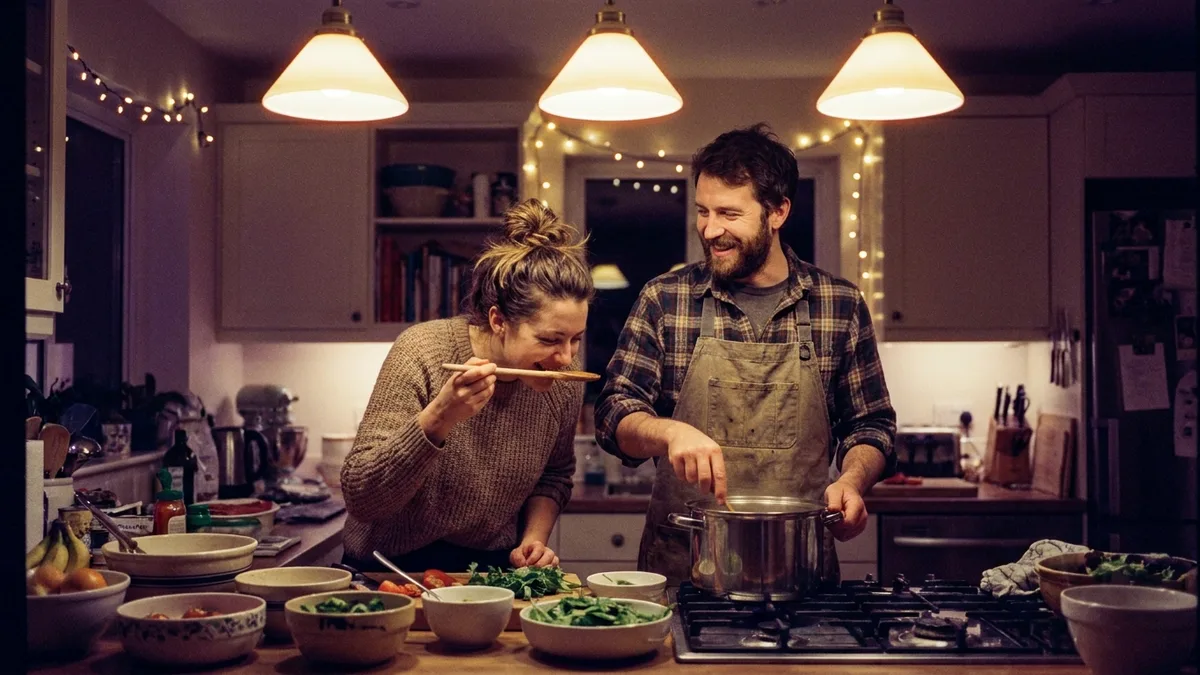
Cook something neither of you has made before
Pick one recipe that requires some actual technique. Not a familiar pasta. Something with a new method, a cuisine you rarely cook, or an ingredient neither of you has used. The small challenges, the flour on someone's shirt, the moment you taste and look at each other, these create real shared memory.
Variations: blind recipe challenge (each person picks a dish for the other without showing them until it's done), a cook-off with a theme, or a multi-course dinner where each of you owns two courses.
Run a blind taste test
Buy five versions of the same thing: olive oils, hot sauces, chocolates, sparkling waters, cheeses. Number the cups or plates. Score them individually, then compare. It creates genuine surprise, a little competition, and actual conversation.
This works because it has stakes. You're comparing notes, you're discovering you disagree about something low-stakes, and you're laughing.
Play a couples question game
Not trivia about the world. Trivia about each other.
The Gottman Love Maps concept is useful here: most couples underestimate how much they don't know about their partner's inner life. Questions like "What's something you wanted as a kid that you never got?" or "What does a perfect Tuesday look like to you?" open rooms in the relationship you may not have entered in years.
Card decks like We're Not Really Strangers, Table Topics Couples, or even a free printable set work well. The format matters less than committing to actually answering.
Build something together
A puzzle. A piece of flat-pack furniture. A terrarium. A meal from scratch. Shared construction activates a different register of collaboration than conversation. You have to negotiate, make small decisions, help each other, and you end the evening with something that exists in the world because you made it.
Write each other letters to read aloud
Set a timer for 15 minutes. Each person writes a letter to the other: what you appreciate, what you want them to know, what you're looking forward to together. Then you read them to each other.
This is uncomfortable for about 30 seconds and then quietly transformative. It creates genuine vulnerability in a container that feels safe because you set it up.
Create an at-home spa evening
Run a bath, find a face mask, give each other a real shoulder massage. The point is not luxury products. The point is full attention with no agenda. You are not accomplishing anything. You are just taking care of each other.
This particular date works especially well when one or both of you is running on empty from work stress.
Recreate your first date (or a favourite early memory)
Order from the same restaurant where you had your first date. Cook the same food you cooked the first time someone made dinner for the other. Put on the playlist from that period. This uses nostalgia as a bonding tool, not sentimentality for its own sake, but a deliberate revisiting of the version of the relationship that was new.
Set up an indoor picnic
Blanket on the floor, candles, food laid out in small plates. The act of eating on the floor at home is oddly freeing. It signals "this is not a regular Tuesday." The change in physical context shifts the mood more than you'd expect.
Virtual museum or gallery tour
Google Arts and Culture offers high-resolution virtual walkthroughs of hundreds of museums: the Louvre, the Uffizi, the Smithsonian, the British Museum. Pick one neither of you has been to. Nominate yourselves as each other's tour guide for a wing. Argue about which painting you'd steal.
Watch one film but actually talk about it
Pick something one of you has seen and the other hasn't, or something neither of you has seen but are curious about. Pause it when something strikes you. Talk about the scene before moving on. Watch it in a way you never watch television on a normal night.
Passive consumption is easy. Attention is the date.
Quick-pick reference: ideas by energy level
| Energy level | Ideas to try |
|---|---|
| Low energy, cozy | Indoor picnic, spa evening, letter writing, watching a film with actual conversation |
| Medium energy, playful | Blind taste test, couples trivia, cooking a new recipe, puzzle or build |
| High energy, creative | Cook-off, vision boarding, learning something new together, photography session at home |
| Sentimental | Recreate first date, look through old photos, write letters, make a shared playlist |
What makes a date night at home actually land
Phone-free for at least 90 minutes. This is not a rule about wellness. It is a practical reality: the average person checks their phone 96 times a day. You cannot be genuinely present and available to notification at the same time.
Dress slightly differently than you would on a regular evening. Not formally. Just not-sweatpants. The small physical signal that this evening is set apart from the rest of the week changes how you both show up.
Start with an intention. Not a ritual, not a manifesto. Just: "Tonight I actually want to hear how you're feeling about X." One question, named at the start.
End without reviewing the to-do list. Resist the habit of closing the evening by running through logistics. The date ends when it ends. The calendar can wait until morning.
When the relationship needs more than a date night
A good date night is maintenance. It keeps the closeness alive between harder conversations. But if you're in a period where the same fight keeps happening, where the distance feels like more than drift, or where one of you is carrying something the other doesn't fully see, a date night is not the repair.
That's where having a space to actually hear each other, separately and honestly, makes a difference. Adoree is an AI relationship assistant that listens to both partners privately, holds both perspectives, and helps you figure out what's actually going on and what to do about it. Not a replacement for the date. The thing that makes the date possible again.
The real goal
Novelty plus attention. That's the equation. You do not need a reservation, a sitter, or a hundred-dollar dinner. You need an evening where both of you are actually there, doing something neither of you has done before, or revisiting something you both love, without the rest of the week bleeding in.
Pick one idea from this list. Start tonight.
Couples who are curious about their relationship and what the other person is actually carrying can also explore Adoree's approach to dual-perspective conversations, or read more about how to reconnect when things feel distant.
Frequently asked questions
What are the best fun date night ideas at home?
Cook a new recipe together, play a couples trivia game, do a blind taste test, build a fort and watch a film inside it, or write each other letters to read aloud. The key ingredient is genuine attention: novelty plus presence creates the strongest bonding effect.
How often should couples have date nights at home?
The National Marriage Project found that couples who go on dates at least once or twice a month report significantly higher marital happiness and sexual satisfaction. Dr. John Gottman recommends two or more hours of intentional quality time per week.
Do at-home dates count as real date nights?
Yes. Research by Aron et al. (2000) showed that couples who shared novel, arousing activities at home reported greater relationship quality than those doing routine pleasant activities. The location matters far less than novelty and full attention.
What makes a date night at home actually romantic?
Atmosphere (candles, good food, phones away), genuine attention, and an element of the unexpected. Even recreating your first date meal in your kitchen or playing a vulnerability card game creates more intimacy than a passive movie night.
What date night ideas work for long-distance couples at home?
Video call dates with synced movie watching, simultaneous cooking of the same recipe, online escape rooms, or a virtual museum tour on Google Arts and Culture. The shared novelty principle applies regardless of physical distance.
Meet Adoree.
Adoree is an AI relationship assistant built for couples. It hears both partners privately, remembers everything, and helps you actually move forward. Free for 3 days.
Try Adoree free →Your version of this
You just read about the pattern. Tell me yours — I’ll tell you which one you’re in.
Three messages, free, no sign-up. Nothing is saved unless you keep it.
References
- Couples' Shared Participation in Novel and Arousing Activities and Experienced Relationship Quality. Aron, A., Norman, C., Aron, E., McKenna, C., & Heyman, R. (2000). Journal of Personality and Social Psychology, 78, 273–284.. https://pubmed.ncbi.nlm.nih.gov/10707334/
- The Date Night Opportunity. National Marriage Project, University of Virginia (2023). https://nationalmarriageproject.org/2023-date-night-opportunity
- Six Hours a Week to a Better Relationship. The Gottman Institute. https://www.gottman.com/blog/weekend-homework-assignment-date-night-in-a-jar/
- Novel activities boost relationship satisfaction through felt security. Journal of Experimental Social Psychology (2020). https://www.sciencedirect.com/science/article/abs/pii/S0022103119308091