

Is this happening to you? Tell me what's going on. I'll tell you what it's really about.
Key takeaways
- Have four specific conversations before December, not in December.
- Start small. Two consistent traditions beat ten that fade by year three.
- The best new tradition is one that belongs entirely to you, not inherited from either family.
- Merging different holiday backgrounds takes one honest conversation, not years of compromise.
- If the first Christmas gets tense, the issue is usually unspoken expectation, not the holiday itself.
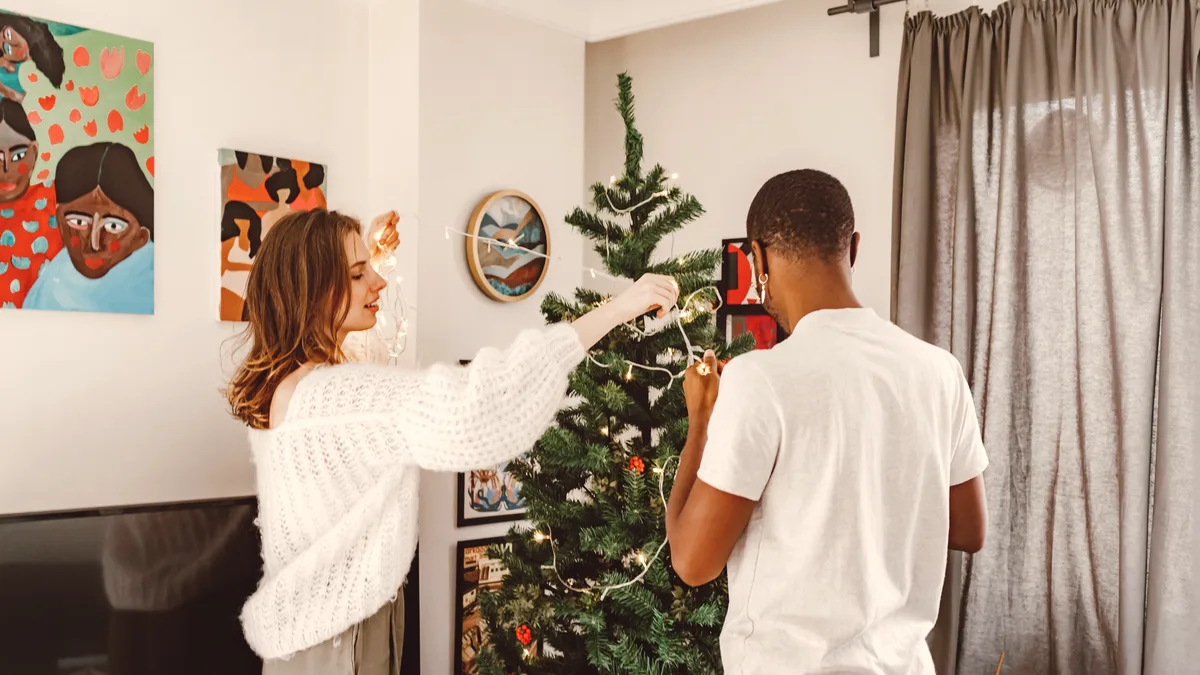
Your first Christmas together is the year you stop inheriting someone else's December and start building your own. Here are 25 traditions worth starting, plus the four questions to settle before the holiday itself.
Why the first Christmas together is different from all the others
Every couple arrives at their first December together carrying a different version of Christmas. One of you grew up opening presents on Christmas Eve; the other waited until morning. One had a chaotic, extended-family celebration; the other had a quiet dinner of four. These aren't incompatibilities. They're material to work with.
The first Christmas together is not just a holiday. It is the first time you have to actually negotiate something you've never had to explain before, with someone who finds it equally obvious. Research on rituals published in the Journal of Experimental Psychology found that consistent rituals increase relationship satisfaction and help couples navigate transitions, partly because they create shared meaning out of ordinary repetition.
What you start this year has a decent chance of becoming what you do every year. That's worth being intentional about.
Four questions to settle before December
The most common source of holiday tension between couples is not conflict about values. It's unspoken expectations that only surface at the worst moment. These four questions, answered in November, eliminate most of that.
| Question | Why it matters | Good enough answer |
|---|---|---|
| Where do we spend Christmas Eve and Christmas Day? | Competing family expectations create last-minute stress if not settled early | Agree on a rotation and stick to it; don't renegotiate each year |
| What does Christmas morning look like, just us? | Morning rituals either get established early or never do | Pick two: coffee first, music on, one film, no phones until noon, whatever fits |
| What is each person's most important part of Christmas? | People protect what matters to them; knowing this prevents small decisions from becoming conflicts | One thing each. Everything else is flexible. |
| Is there anything from our separate Christmases that we don't want? | Carrying forward traditions out of habit, not love, adds weight | Name them now, quietly, so they don't become defaults |
Settle these before the first week of December. Revisiting them mid-December is harder.
25 traditions and ideas to start this year
The 25 ideas below are organized by category, from quick rituals to things that build over years. Start with two or three that genuinely fit how you live. The traditions worth keeping are the ones that feel natural by year three, not the ones that required the most effort to begin.
New rituals (the ones that become your signature)
- One dated ornament per year. Not themed, just marked with the year and something brief about what it was. The tree becomes a timeline.
- A Christmas Eve handwritten card. Not a gift. Just words you wrote. Keep them.
- Same photo spot, every year. A specific place in your home or a place you visit. Same frame, different year.
- The memory jar. Write down one moment from the year on December 1st. Open it next Christmas before you add the new one.
- Your Christmas playlist. Start it this year. Add songs every season. Never delete.
At-home rituals
- Establish Christmas morning order before it happens: coffee first, then music on, then whatever comes next. The small rituals are what make mornings feel like home.
- One dish you cook together every Christmas Eve. It doesn't have to be elaborate. It just has to be yours.
- A film that runs every Christmas Eve, no exceptions. Pick one this year.
- Bake something together the first weekend of December. The act matters more than the outcome.
- Matching pajamas on Christmas morning. Unnecessary. Worth it.
Getting out
- Christmas lights in a new neighborhood each year. Drive slowly. No commentary required.
- One live event per season: a carol service, a concert, a Nutcracker, anything with other people singing in a room.
- Volunteer together at least once during the season. Food bank, shelter, whatever is nearby. It resets the holiday quickly.
- For specific date-night ideas during the season, the winter date ideas guide has a full section on Christmas and holiday dates.
Building meaning
- A December 1st intention. On the first of the month, each of you names one thing you're genuinely looking forward to this season. Write them down.
- Advent surprises. Twenty-four small notes or activities, made by each partner for the other, one per day. Low effort, high return.
- The gift that marks the year. A photo book, a printed map of somewhere you went, a dated object. Something that will mean more in ten years than it does now.
- One tradition that has no history. Entirely invented. Not inherited from either family. This one is yours.
Managing family
- Set the holiday rotation once. Decide the pattern for whose family you're with and when, and treat it as a default rather than a decision you make fresh each year.
- Give yourselves a departure time. Agree on it in advance. Leave together when you said you would.
- Establish one thing you do just the two of you before or after larger family gatherings. Even an hour.
- Tell one family about one new tradition you're starting. It signals that you're building something together. Most families find that reassuring.
Quiet season rituals
- A slow morning somewhere in December with no obligations. Coffee, no phones, nowhere to be. Put it on the calendar now.
- Write down three things about this year before December ends. Not goals, just observations. You will want them later.
- Start next year's list in January. One thing each of you wants to do together before next Christmas. Seal it, open it in November.
When your Christmases looked completely different growing up
Different holiday backgrounds are more common than couples expect. One partner's family opened presents at midnight; the other's at 10am. One grew up in a religious celebration; the other in a secular one. One person doesn't celebrate Christmas at all.
None of these are incompatible. They become problems when each person assumes the other will naturally adapt.
| Situation | What actually helps |
|---|---|
| Different gift traditions (big presents vs. small, many vs. one) | Agree on a rough budget and number before you shop, every year |
| One partner's family has more intense expectations | The partner whose family it is runs point; don't leave the other to manage it alone |
| One partner doesn't celebrate Christmas | Find the shared value: rest, generosity, being together. Build December rituals around that |
| Religious vs. secular celebrations | Acknowledge both if that's real for you; find the parts of each that feel genuine to both |
| One partner loves the holiday, one is indifferent | The enthusiastic partner takes the lead; the other shows up with genuine presence, not performance |
The couple whose traditions stick are not the ones who perfectly merged two Christmases. They're the ones who decided together what mattered and let the rest go.
If the first Christmas gets tense
Holiday tension between new couples usually traces back to one thing: an expectation that wasn't said out loud before it became a disappointment. Someone's family says something. Plans fall apart. One of you expected something that wasn't communicated. The day feels nothing like it was supposed to.
When that happens, the holiday is rarely the issue. The issue is usually an unspoken expectation that surfaced too late, or the weight of two different families' needs falling on one day.
If you notice tension building, name it without blame: "This feels harder than I thought it would. Can we talk about it?" That question, asked quietly, redirects most holidays back toward each other.
If the two of you are navigating a recurring pattern around holidays and family, Adoree is an AI relationship assistant where both partners can think through what they actually want, separately, before they have to agree on it together. The about page has more on how it works.
For Christmas date ideas specifically, the winter date ideas guide has a full section on the holiday season, including lights, markets, and cold-weather plans for every budget. For more on building a life together beyond the holidays, the answers hub has practical guides on the questions couples ask most.
Frequently asked questions
What do you do on your first Christmas together as a couple?
Start by settling a few things in advance: where you'll be, whose family you'll see and when, what your morning looks like. Then pick one small new tradition to begin together. It doesn't have to be big. It just has to be repeatable.
How do you spend the first Christmas with a new partner?
Talk about expectations early, ideally in November. Where do you spend Christmas Eve and Christmas Day? What matters most to each of you? Getting clear on those answers together prevents the most common sources of tension during the holiday itself.
What is a good first Christmas gift for a couple?
Something that marks the year: a dated ornament, a photo book of the year, or a planned experience you'll do together. The best first-Christmas gifts are ones you'll still have or remember in ten years.
How do you blend two family Christmas traditions?
Agree on a rotation for where you spend the holidays and stick to it rather than renegotiating each year. Then build at least one tradition that belongs entirely to you two, with no history from either family.
What if one of us doesn't celebrate Christmas?
Find the shared value underneath the holiday: rest, togetherness, generosity, light. Build a December ritual around that. You don't have to celebrate the same holiday to build shared meaning in the same season.
Ask Adoree
You just read about it. Now tell me yours — I'll tell you what it's really about.
References
- Holiday Stress and the Holidays. American Psychological Association. https://www.apa.org/topics/stress/holiday
- The Science of Rituals: How Traditions Strengthen Relationships. Journal of Experimental Psychology: General (Norton & Gino, 2014). https://psycnet.apa.org/record/2013-28257-001